I spent a lot of time reading when I was younger. I spend a lot of time reading now. It is probably not surprising that someone who writes also reads, also feels solace in it. I treat it right. I read attentively. I take notes. I study.
I don't think it's fair to say that I was raised just so. I think my parents actually kept the reins pretty lose and followed us where we went. I think that the part of me that is just so, is just that, part of me. Not an external thing. Not some causal relationship. Not some scar of time and love.
We all have ropes in us. They're held together by torque and when we try to toe them, they move. The rope I toe these days has to do with spectacle and self: ways in which I can stand to have people look at me and ways I can't.
Tonight I am reading some poems.
Thursday, July 7, 2011

Friday, February 18, 2011
Sometimes you just need to kill it by force feeding it white meals.
So, I'm scared of writing fiction. As the lovely and honest Abigail Ohlheiser pointed out to me a couple years ago, I am exposition-avoidant. I don't use it in conversation. I don't use it in writing. I also don't talk like most other people I know, which makes it challenging to construct convincing dialogue.

But when Brian Cook and I decided to make a vintage design and cooking project, it occurred to me that a period-appropriate story might fit well. So I tried.
And where better to start, I figured, than a story about murder by scurvy? Here it is.
Tuesday, February 15, 2011
Blood and pomegranate juice are not the same color.
I have been slow to write here these days. When I started this blog, it was as a way to do poetry planning, loosely. Over the years, the way I've planned out these things has shifted. Oddly, I think, having digital platforms for composing has led to an analogue practice that I find really stimulating. Now, for almost every poem I write, I make a poem planning sheet. These are somewhere between notes and diagrams, between ideas and compositions.


They don't always give rise to poems, though, as in this most recent case, which became an essay on thenervousbreakdown.com. You can, and should, read it here.
Monday, December 28, 2009
"Some Things Just Stick in Your Mind"
Some memories play over like good records. Today is grey; yesterday was grey. We're in the grey of winter and I've been playing over the time we lost Patrick in my head. I've been waking up with it in the middle of the night; I've been holding it with my morning coffee.
It was this time of year - a little before Christmas. Mom was pregnant with Nora. Earlier in the day we had gone up the Empire State Building with Uncle Bill. In the elevator we thought of names for Nora. Patrick and I, with uncomfortable ears, distracted ourselves with dinodahn names. We figured out, I think it was for the first time, that many names when paired with "Dahn" become dinosaur names. Irena Dahn. Carlotta Dahn. Umberto Dahn. Madonna Dahn.
My grandparents had an apartment in White Plains that grandpa used when he was in the city on business. It had what my child's mind perceived to be an extensive roof garden, multi-leveled and well-populated with nooks and topiaries. We left mom and dad, looking at stars, embracing at the edge of the terrace. We played hide and seek.
It was dark and large and I couldn't find him. I looked and looked and eventually interrupted my parents to enlist their help. We looked everywhere. We couldn't find him. I started looking over the edges of the wall; every time I looked over a new edge I was clutching my core in preparation for something I didn't want to see.
These past days when I've woken up in the middle of the night with this memory, it's been to the image of Patrick's little body at the foot of that building. And it's always with that same clutch in your core, isn't it, when you have to prepare for something you don't want?
He was fine. He had gotten lost and wandered inside.
He left yesterday to move to Paris. No one ever said dreams were subtle.

He's left the stewardship of his record collection to me. I'm hoping they get stuck in my head.
Tuesday, October 27, 2009
"What are borders and pieces of paper and different tongues in different mouths compared to desire, to heart?"

(Image by Ben Gancsos)
I've been thinking a lot these days about integrated art forms and lenses, perspectives and approaches, and how these confluences shape the articulations we make.
This weekend, I attended a preview of The Parkville Project, a production of the new Bated Breath Theatre Company. The company interviewed community members, business people, and senior citizens. They reviewed historical documents. And they used this information to create a piece that combines creative movement, text, music, and photographic projections. The actors moved through the space and, in so doing, implicated the audience in the action of the play.
I was thoroughly excited by it. I wrote a little thing thing, here.
Friday, October 23, 2009
Braiding Media

I've been thinking for some time about how paradigmatic shifts in media affect cultural production. Today I have a post up on Listen, Dammit about the Chicago band Califone's new film/album project All My Friends are Funeral Singers.
Monday, September 7, 2009
Making fun of neurotic writing habits
Some people write postcards to their loved ones; I write postcards to my GP.

You can read about it at thenervousbreakdown.com.

Thursday, September 3, 2009
On the geographical, on distance
Since moving to Hartford, I've wanted to write about it. I've wanted to write about it in a way that doesn't feel earned. I often wonder how much I can really claim to be here. I spend time at work and at home - so that the moments of feeling in this place stand out:

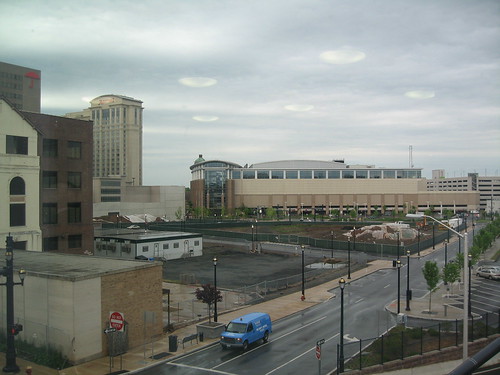
But, for the most part, I've felt fairly disconnected from an experience of Hartford that I could present to a general audience.
• • •
Last night I was watching Bas Jan Ader fall from a tree, fall from a roof, fall with a bike.
Gravity everywhere, even in tears.
• • •
I was thinking of sitting up in a tree with Jillian and her telling me about her climbing prowess and near disasters. It settled in that the moments that have been most meaningful in this place, many of them have been on walks with Jillian, cradled in branches with Jillian, wanting to swim in a river with Jillian, standing on a cliff with Jillian.
I feel like I'm losing part of my geography.
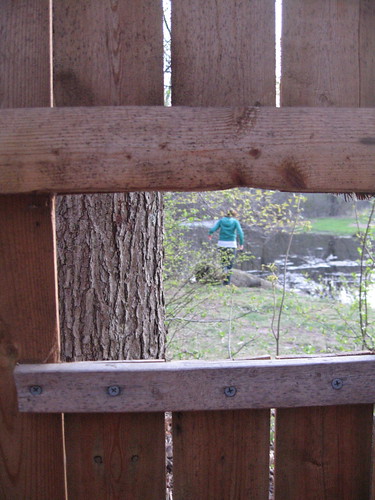
But I'll write you stories about getting lost.
walking during snowstorms
obsessive photography
being perched up high for the excellent Branching Out series
But, for the most part, I've felt fairly disconnected from an experience of Hartford that I could present to a general audience.
• • •
Last night I was watching Bas Jan Ader fall from a tree, fall from a roof, fall with a bike.
Gravity everywhere, even in tears.
• • •
I was thinking of sitting up in a tree with Jillian and her telling me about her climbing prowess and near disasters. It settled in that the moments that have been most meaningful in this place, many of them have been on walks with Jillian, cradled in branches with Jillian, wanting to swim in a river with Jillian, standing on a cliff with Jillian.
I feel like I'm losing part of my geography.
Photo by Faith Antion
But I'll write you stories about getting lost.
Tuesday, March 24, 2009
And I was calm as the plane went down
Sometimes I wake up with a line of a poem stuck in my head.
I've been thinking these days about that space above the things on which we focus. Sometimes, it's the sky:

Sometimes it's the walls and ceiling of a natural history diorama:
Last night I dreamed that the plane I was in clipped the Sydney Opera House before it went down. We were hovering above that eminently photographable skyline identifier.
I've never been the kind of poet that writes from dreams. I write from research. I read. I visit archives. I look through photographs. Frankly, I don't know how to write a poem from a dream; I don't know how to make that relevant to a wider audience than myself.
But I like waking up with a series of words in my head that I trust to be a line of poetry.
I've been thinking these days about that space above the things on which we focus. Sometimes, it's the sky:
Sometimes it's the walls and ceiling of a natural history diorama:
Last night I dreamed that the plane I was in clipped the Sydney Opera House before it went down. We were hovering above that eminently photographable skyline identifier.
I've never been the kind of poet that writes from dreams. I write from research. I read. I visit archives. I look through photographs. Frankly, I don't know how to write a poem from a dream; I don't know how to make that relevant to a wider audience than myself.
But I like waking up with a series of words in my head that I trust to be a line of poetry.
Wednesday, March 4, 2009
Mute and hardly active

The past several days, I've had the distinct feeling of being mute. I feel as though I'm giving stillbirth to words.
I haven't written anything about which I'm content in longer than I can remember.
I need to be bolstered up and ordered by something, but I'm not sure what that might be.
Tuesday, March 3, 2009
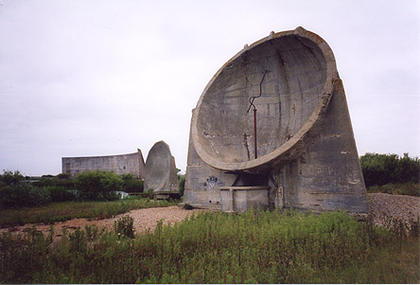
I wish to curl up in a vast and obsolete cement ear.
These days, I've been dreaming about Ireland, about the UK.
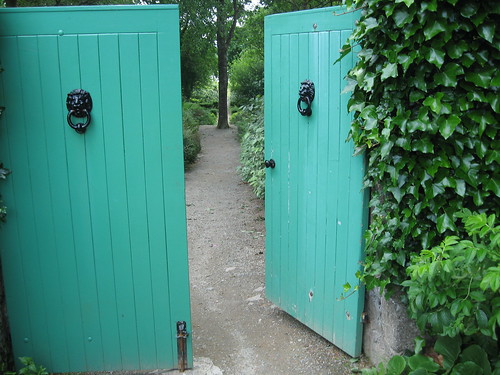 [Jillian Green doors everywhere.]
It happens a couple times a week and it's things as specific as basking in dappled aprication (the best way one can, I think) in some NUI garden in Galway, with the smell of it and every blade of grass making its way through my dress to my skin. It's as tangential as incorporating a street into another cityscape. It's been a room in a Cardiff of my imagination.
Tonight, it's my wish that my self-conscious will allow me to curl up in a vast and obsolete cement ear.
[Jillian Green doors everywhere.]It happens a couple times a week and it's things as specific as basking in dappled aprication (the best way one can, I think) in some NUI garden in Galway, with the smell of it and every blade of grass making its way through my dress to my skin. It's as tangential as incorporating a street into another cityscape. It's been a room in a Cardiff of my imagination.
Tonight, it's my wish that my self-conscious will allow me to curl up in a vast and obsolete cement ear.
Monday, February 9, 2009
Hitch and turn
Sundays are my favorite. It's the time of my week I allow myself a kind of stillness in the space of the day to contemplate and stretch and read and cook and do whatever it is I'd like. I suppose I'm conventional in that way.
I spent some time yesterday listening to the absolutely dreamy Solitude Trilogy by Glenn Gould. I also watched The Weather Underground, which of course makes me think about poetry. (Documentaries do that to a girl - all that carefully constructed and overlapping language, palimpsestic discourse.)

I have been really struggling with how to negotiate my relationship to poetry lately. I haven't written anything that I would consider finished or polished in far too long. I've been re-reading old work with disdain (I know this isn't that strange an occurrence, but that doesn't make it any more pleasant).
On the other hand, I can feel the influence of the kind of thinking poetry engenders in most aspects of my life more keenly than I have in some time. Yesterday, I worked on a sound project for hours - recording it, considering how best to score it. What I have in mind, could, indeed, read like poetry, I think, but it's footing there isn't secure. I'm picturing something that would owe a great deal to a Benjamin J. Mansavage Klein score: a layered thing that you peel back and reveal to yourself in shifting ways each time. Another possibility would be to set it up as telescopic web text.
The difficulty that this little sound project is so clearly a component of is my tendency of late to write very little that isn't part of a kind of closed circuit. I can imagine this being quite a lovely sort of new media, multi-disciplinary sound poem, but I am making it for a very particular audience: me and one other person. I've been feeling similarly about the Charcot poems, too. I begin to suspect that they comprise an entire book that I wrote to myself...or perhaps to multiple selves (a self of circa 1995-1999, a self at a specific future point, et al). My insomnia series is definitely not for public consumption, but it's a really compelling project, nonetheless.
When I was a teenager I was adamant that essays and poetry were close kin, that there is a kind of hitch of logic or turn of mind that occurs in both, when they are successful. I find myself, more and more these days, full of hitch, full of turn, but lacking a way of wedding those steps to some kind of appropriate means of public consumption.
I spent some time yesterday listening to the absolutely dreamy Solitude Trilogy by Glenn Gould. I also watched The Weather Underground, which of course makes me think about poetry. (Documentaries do that to a girl - all that carefully constructed and overlapping language, palimpsestic discourse.)
I have been really struggling with how to negotiate my relationship to poetry lately. I haven't written anything that I would consider finished or polished in far too long. I've been re-reading old work with disdain (I know this isn't that strange an occurrence, but that doesn't make it any more pleasant).
On the other hand, I can feel the influence of the kind of thinking poetry engenders in most aspects of my life more keenly than I have in some time. Yesterday, I worked on a sound project for hours - recording it, considering how best to score it. What I have in mind, could, indeed, read like poetry, I think, but it's footing there isn't secure. I'm picturing something that would owe a great deal to a Benjamin J. Mansavage Klein score: a layered thing that you peel back and reveal to yourself in shifting ways each time. Another possibility would be to set it up as telescopic web text.
The difficulty that this little sound project is so clearly a component of is my tendency of late to write very little that isn't part of a kind of closed circuit. I can imagine this being quite a lovely sort of new media, multi-disciplinary sound poem, but I am making it for a very particular audience: me and one other person. I've been feeling similarly about the Charcot poems, too. I begin to suspect that they comprise an entire book that I wrote to myself...or perhaps to multiple selves (a self of circa 1995-1999, a self at a specific future point, et al). My insomnia series is definitely not for public consumption, but it's a really compelling project, nonetheless.
When I was a teenager I was adamant that essays and poetry were close kin, that there is a kind of hitch of logic or turn of mind that occurs in both, when they are successful. I find myself, more and more these days, full of hitch, full of turn, but lacking a way of wedding those steps to some kind of appropriate means of public consumption.
Monday, February 2, 2009
Discovering strange little poetic moments on the Web
I've done something delightful to my browser. Michael Day, an artist whose work I esteem in great measure, has put together an exhibit through Add-Art. Add-Art utilizes a firefox plug-in to replace all web ad content with art. Lovely.

Michael Day, Filter 5
So, for instance, yesterday, when I was looking up the last lines of "The Dead," I saw this:

I've noticed that having the ad content replaced changes the quality of the way I read on-line. It's more still; there are fewer moments in which I feel tugged in ten directions.
I've written a small bit of text to go along with the exhibition, which you can read here or here.
Michael Day, Filter 5
So, for instance, yesterday, when I was looking up the last lines of "The Dead," I saw this:

I've noticed that having the ad content replaced changes the quality of the way I read on-line. It's more still; there are fewer moments in which I feel tugged in ten directions.
I've written a small bit of text to go along with the exhibition, which you can read here or here.
Saturday, January 10, 2009
Pigeon-finity...
Things I have learned this week:

- reading about boredom does not always create enough intellectual stimulation to stave off boredom (Heidegger, I'm talking to you)
- once you start researching boredom, you will never be able to use the word "interesting" without being self-critical
- pigeons are commuters
- Wordpress is really, really annoying
Thursday, December 25, 2008
The intimate mathematics of gravity on the body that has not slept
This winter more than any other I can remember, I've redefined my relationship to snow, and to walking in it.
I haven't been sleeping properly this season - it's either been over-long and oddly ineffective (waking up with every muscle thoroughly drained of energy) or it's been totally absent.
I started a poetry series of little things that I write exclusively when sleep-deprived. I wrote another just now. Last night I couldn't sleep. I sprawled out and flipped through sundry books; I took other books off my parents' shelves (Connolly's selected writings were too intense, Portrait of the Artist as a Young Man - with another person's marginalia - was much too compelling); I paced; I looked at things. Eventually, I took a walk in the woods that surround may parents' house. The moon wasn't out, but the snow gave off the most gorgeous ambient light.
Someone had been cross-country skiing up there. I wonder how they were able to avoid branches.
I listened to the trees creak. I held onto their trunks when the wind made them sway.
I rested at the top of the hill, determined to wait until I heard an owl. I did.
And as I started to return home, I saw a coyote. It looked at me. I looked at it. We parted ways.
I came home and thought about things. Earlier in the night, I had heard my father murmur that my mother is so beautiful as he was falling asleep. What a privilege to grow up amidst a love as deep as theirs.
Who could sleep in the face of that?
I haven't been sleeping properly this season - it's either been over-long and oddly ineffective (waking up with every muscle thoroughly drained of energy) or it's been totally absent.
I started a poetry series of little things that I write exclusively when sleep-deprived. I wrote another just now. Last night I couldn't sleep. I sprawled out and flipped through sundry books; I took other books off my parents' shelves (Connolly's selected writings were too intense, Portrait of the Artist as a Young Man - with another person's marginalia - was much too compelling); I paced; I looked at things. Eventually, I took a walk in the woods that surround may parents' house. The moon wasn't out, but the snow gave off the most gorgeous ambient light.
Someone had been cross-country skiing up there. I wonder how they were able to avoid branches.
I listened to the trees creak. I held onto their trunks when the wind made them sway.
I rested at the top of the hill, determined to wait until I heard an owl. I did.
And as I started to return home, I saw a coyote. It looked at me. I looked at it. We parted ways.
I came home and thought about things. Earlier in the night, I had heard my father murmur that my mother is so beautiful as he was falling asleep. What a privilege to grow up amidst a love as deep as theirs.
Who could sleep in the face of that?
Saturday, December 13, 2008
"on its string. Birdlike, the almanac"

What perfect timing, I thought, to come across this article about the discovery of the oldest known brain in Britain, just as the days for An Archaeology of Wonder are dwindling away.
One of the most beautiful things about the discovery, at least as far as I can tell from the articles I read, is that it's of no neurological import. This will yield no significant information about the human brain, itself remaining essentially unchanged, they claim, in the last 2,000 years. So then, it's an object of auratic wonder - that thing which has somehow (and here's what they're trying to figure out) bent the rules of time and decay.
No other soft organs but it.

It was Randy who suggested, when I enthusiastically declared that I was "SO going to write a poem about this," that I make it a sestina. Good advice. I'm in the midst of mapping it out. How appropriate.
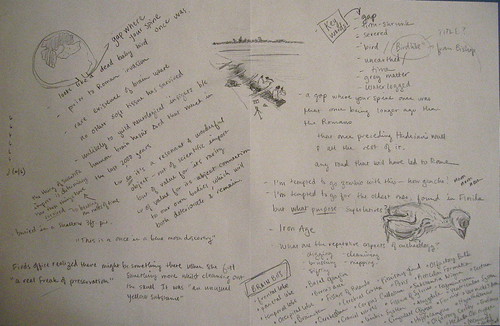
My notes...
Wednesday, December 10, 2008
Wading ankle-deep in the bluebells
I've felt so much like Leonard Bast these days.
I think it's partly that I'm writing about culture and class in various places, so there are obvious associations there. But in some more fundamental way, I have been either fighting or succumbing to the urge to walk off into the night for the last couple weeks.
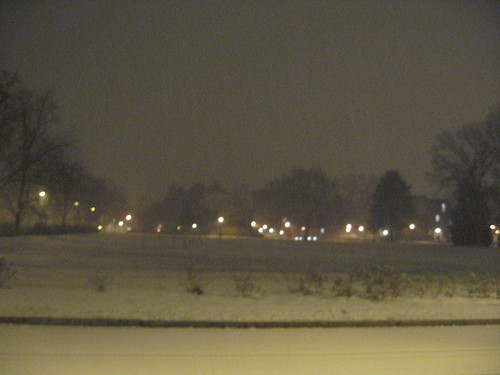 Taken at 3:13 a.m.
Here's to not getting crushed.
I think it's partly that I'm writing about culture and class in various places, so there are obvious associations there. But in some more fundamental way, I have been either fighting or succumbing to the urge to walk off into the night for the last couple weeks.
Taken at 3:13 a.m.Here's to not getting crushed.
Sunday, November 30, 2008
On my magnificent good fortune
Tonight, sitting in the 32-degree cold and rural dark outside of my sister's house, I saw three shooting stars.
"One for each of us," I thought. Nora, Patrick, and me.
I am extraordinarily lucky to have these people I so admire and love as my siblings and ballasts.
"One for each of us," I thought. Nora, Patrick, and me.
I am extraordinarily lucky to have these people I so admire and love as my siblings and ballasts.
Thursday, November 27, 2008
Good idea or lack of sleep?
It could well be the lack of sleep that's behind this idea, but I am really taken with it.
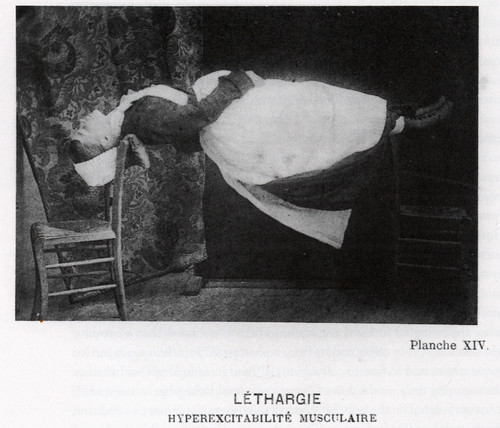
One of the theories about what was so unnerving about hysteria in the 19th century was that it disrupted language, so that signifiers and referents would become blatantly unhitched in the mouths of the patients. This relationship to language was part of the reason I wanted to write the series of poems in the first place. What better than poetry to deal with this sort of fear?!
I've struggled off and on with insomnia for my as much of my life as I can remember. It wasn't really until I was older, though, that it started to make me panic when I couldn't sleep. As a child, it just seemed like one of those things that sometimes happens - and it allotted me time to myself that was still and quiet, something I've always already needed anyway.
I hardly slept at all last night, maybe and hour and a half - 5:30-7:00 a.m. It's 9:44 p.m. right now.
Halfway through this morning I had the idea to start of cycle of poems only written when extremely exhausted. Exhaustion unhinges my ability to use language (I can't tell you how hard I am concentrating now to write this!) just enough that interesting things begin to happen. I'm not certain that the poems from these cycles would end up finished in themselves, but they are certainly things I'd be hard pressed to come up with in other states.
So, here's the idea that makes me excited. What if I created a new section of the hysteria/Charcot book based on these insomnia poems? They certainly mirror the radical disjunction of the language the patients used (at least insofar as how it's represented in the medical journals).
It seems like a really good idea now. I shall have to put it to the test when I've slept.
One of the theories about what was so unnerving about hysteria in the 19th century was that it disrupted language, so that signifiers and referents would become blatantly unhitched in the mouths of the patients. This relationship to language was part of the reason I wanted to write the series of poems in the first place. What better than poetry to deal with this sort of fear?!
I've struggled off and on with insomnia for my as much of my life as I can remember. It wasn't really until I was older, though, that it started to make me panic when I couldn't sleep. As a child, it just seemed like one of those things that sometimes happens - and it allotted me time to myself that was still and quiet, something I've always already needed anyway.
I hardly slept at all last night, maybe and hour and a half - 5:30-7:00 a.m. It's 9:44 p.m. right now.
Halfway through this morning I had the idea to start of cycle of poems only written when extremely exhausted. Exhaustion unhinges my ability to use language (I can't tell you how hard I am concentrating now to write this!) just enough that interesting things begin to happen. I'm not certain that the poems from these cycles would end up finished in themselves, but they are certainly things I'd be hard pressed to come up with in other states.
So, here's the idea that makes me excited. What if I created a new section of the hysteria/Charcot book based on these insomnia poems? They certainly mirror the radical disjunction of the language the patients used (at least insofar as how it's represented in the medical journals).
It seems like a really good idea now. I shall have to put it to the test when I've slept.
Monday, November 24, 2008
"Old Suzy made me stand where I was and came over and brushed all the snow off of me."
About a year ago now, I wrote a poem about Thumbelina and the early days of my parents' courtship. Today, I read this remarkable post by my beautiful friend Sarah. It's about Champlion's General Store - the place both my mother and I worked in our early twenties, the place my parents lived when they first got together, the place I learned how to start a fire in a woodstove, and the place I was cured of many, many ailments.

I'll be thinking of Bob a lot through this season.
It might be time to revise that poem with some detail from the Daily Campus article.
I'll be thinking of Bob a lot through this season.
It might be time to revise that poem with some detail from the Daily Campus article.
Subscribe to:
Posts (Atom)
