Site Meter Peculiar Susceptibility: photography
Showing posts with label photography. Show all posts

Tuesday, March 24, 2009

And I was calm as the plane went down

Sometimes I wake up with a line of a poem stuck in my head.

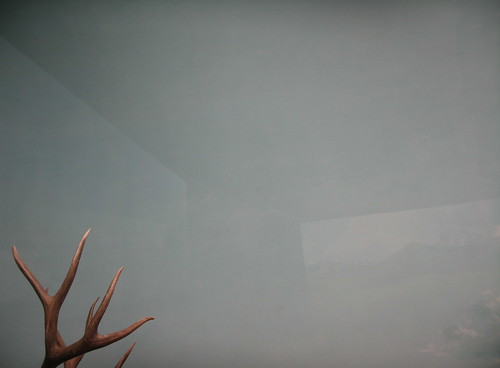
I've been thinking these days about that space above the things on which we focus. Sometimes, it's the sky:


Sometimes it's the walls and ceiling of a natural history diorama:


Last night I dreamed that the plane I was in clipped the Sydney Opera House before it went down. We were hovering above that eminently photographable skyline identifier.

I've never been the kind of poet that writes from dreams. I write from research. I read. I visit archives. I look through photographs. Frankly, I don't know how to write a poem from a dream; I don't know how to make that relevant to a wider audience than myself.

But I like waking up with a series of words in my head that I trust to be a line of poetry.

Wednesday, June 4, 2008

repetition and wonder

It's a rainy June morning. I kept the windows open last night, so there's a cool, wet breeze coming through to my living room along with all the sundry sounds of rain. It feels like England.


My neighborhood, Greencroft Gardens, right off Finchley Road, NW6

The house in which I lived in South Hampstead was on a quiet block near the Freud Museum. Women pushed prams most mornings, regardless of the weather. The clear plastic awnings that covered the children were speckled with a hundred rain drops, miniscule demi-worlds to capture a million-some details of the neighborhood's skyline. I always wanted to take a photograph from within there. The slate walks turned the deepest grey-brown in the rain and the modest trees smelled more like trees.
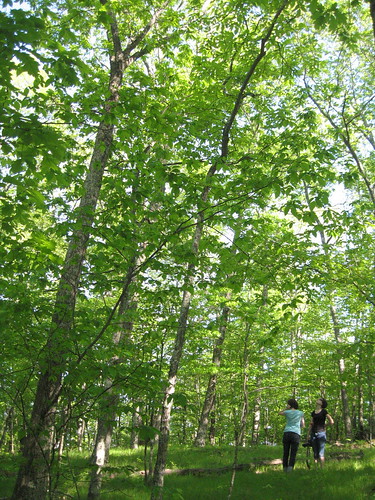


But, now, I am in my native Connecticut. The leaves on its stunning trees are now completely open. The Velvet Underground is on the record player and I am thinking of home. I'm thinking of things that we do over and over and return to with wonder. If wonder is the feeling of astonishment - that's not quite it - the feeling of our selves being thrown into a position from where we can no longer depend on our own significance in the face of some object, some occurrence, then how does it relate to something we do ritualistically?

For myself, I'm thinking of the woods, of the course I tend to track through them. Decades before my parents put in the riding ring, before any proper trails were established by Joshua's Trust, I would wander through the woods - so thick that the air looks green - and perch on boulders or test my balance on the edge of a cliff. I repeat these tests, these reveries regularly.

The people to whom I bring up Gilles Deleuze, tend not to have very positive responses to him. But I'm wondering if I could use something about what he has to say about repetition and pair it with Stendhal's description of what happened to the body-in-wonder when he was in Florence in order to hazard a guess about how ritualistic wonder works.

I think of the maps my father made me - my father, the map maker; my father, the poet - he would hide something for me in the woods and make a map, filled with fanciful names and "100-year Sugar Maples"s. He would stain the paper in tea to "age" it and he would burn the edges. He would make, in short, a world of measurement and wonder.

I'm trying to collect stories about how people approach wonder. Do you photograph it? Do you make videos? Or do you sit - so quiet - and watch?
Thursday, May 1, 2008

It works because we wonder ourselves into it


by Faith Antion

It keeps making its way to the surface, these days, some or other configuration of the idea that our sympathies can be gained (as viewers, as readers, as spectators in the world) when we sense a kind of transfiguration or threat to the human body.

I touched on it weeks ago, when I tried to suggest to my students that part of what's at work in Dorothea Lange's photos of migrant farmers (at least for me) is the immediate queasiness I feel when I see another person's bare feet in dusty dirt. I can't help myself - my throat instantly constricts and I grab the nearest glass of water, the closest bottle of lotion.

dorothea lange
by Dorothea Lange

It reared its head again, this idea, as we were discussing an excerpt of Camera Lucida by Roland Barthes. In it, Barthes starts to investigate the structural elements of several photographs from rebellion-torn Nicaragua. I decided I wanted to find out what would happen if the students looked at a long series of photographs of their choosing.  For whatever reason, a bunch of the students ended up looking at photos of people with deformities - a child with its brain encased in a thin membrane that is an outgrowth of its scull, children with limbs that grew backwards, men so emaciated by Chernobyl-induced cancer that the students wondered if what they saw was a trick of the camera.  We wanted to, or at least I wanted them to, establish a system that would account for the responses we feel to bodies in pain (even as I write this I'm aware of the complexities of creating such a system, of manufacturing such a "we").


Kooza contortionists - where do their organs go?

I think there's something to the idea that when we combine the sympathy we feel for other human bodies with the threat of injury we imagine to our own that results in a very compelling kind of fascination and repulsion.

• • •

As a note (I wonder if this is at all interesting), this post has been sitting in my drafts for days and days, weeks, really. I've really struggled to let it go because it feels unfinished. There's a lot I still want to say about regarding other people's pain or potential pain that I can't quite properly verbalize at this point. But I've decided just to relinquish this post. What the hell - it's a blog; I can always come back to the idea again later.

Sunday, March 16, 2008

you can't take it with you

I do not have great chronological mastery of my memories. They tend to flash before me like so many birds. Sometimes they sit still, wait long enough for me to take a good look, to take in the tawny spectrum of their feathers. Other times they undulate in the sky - their swarming dance not unlike the pull and recoil of algae in a tidal pool. Still other times they dart across my field of vision so fast they are the merest suggestion of a being.

bird impression

"A beautiful subject can be the object of rueful feelings, because it has aged or decayed or no longer exists. All photographs are memento mori. To take a photograph is to participate in another person's (or thing's) mortality, vulnerability, mutability. Precisely by slicing out this moment and freezing it, all photographs testify to time's relentless melt." - Susan Sontag, On Photography

The photograph I've placed above was taken by a woman who was on her last visit to her dying mother. In the same batch, she has posted the last photograph she took of her mother. Her mother is in a hospital bed, in the photo, with tubes - oxygen and something intravenous. She looks frail and tired (as one would). The woman notes, in her caption, that her mother was at an excellent nursing home, where she was pampered.

About a month later, after her mother had died, the woman returned to Honolulu with her brother. They climbed to the top of the highest hill in the city, where their parents wished to scattered, and took this photograph of the site:

where their ashes will go

I think there was a pretty significant paradigmatic shift that came with the popularization of photography. It seems to me that we know better how to negotiate our experiences through this medium.


I remember three things mainly about my grandfather's funeral: (1) it was surprising to see my father, my uncle Freddy (from the other side of the family), and Bob Cook standing together; (2) the room smelled musty and I was concerned that I would sneeze inappropriately; and (3) my grandfather's hands were harder than I'd expected and cold. I don't know if I would feel differently now about his hands if I had photographed him, but my impulse is to guess that I would, to guess that the thing would grant me aesthetic distance.

Photobucket

• • •

Later on the day of my grandfather's funeral we sat on my aunt's porch and Bob Cook gave my little cousin Robby things to throw into the chiminea - scraps of paper, receipts, a soda can, a hard boiled egg.

Saturday, February 16, 2008

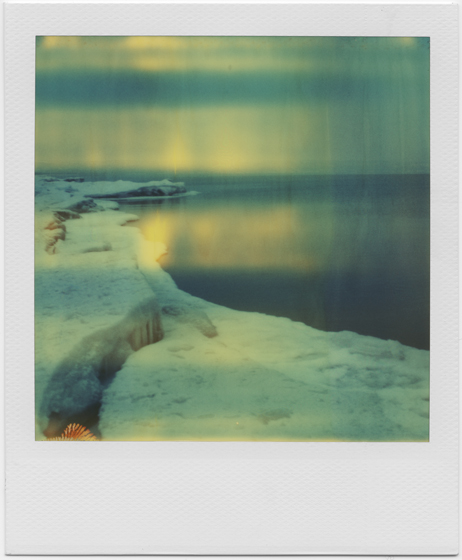
Polaroid RIP


I never owned Polaroid camera. We had other things at my parents' house: a cute and dear brownie camera, a nice 35mm Canon, even sundry cheap point and clicks for my siblings and me. But there was something about Polaroids that didn't suit my mother's photographic inclinations. She's never said as much, but I think there was something she considered crass about Polaroids - their indulgence of instant gratification (although, I think what actually happens here is more subtle and complicated...), their room for captions, their smell, even.

But I liked them.
I liked the smell (my mother and I often differed in our olfactory judgments - she wondered how on earth I could possibly like the smell of gasoline, for instance). I liked the tension between quick gratification and delayed pleasure that those moments spent waiting for the image to emerge engendered. I liked the look-shake-look pacing of it all.

And I liked the kinder, more impressionistic image that resulted. This could have had something to do with my poor eyesight. I still remember how alarming it was when I first got glasses (at 7) and the world became sharp. All of it turned promptly from soft and indistinct to sharp - the things I saw and the headaches I had. Trees suddenly had individual leaves; signs had words on them; sounds in the woods had animals dashing. Still, this vividness sometimes seemed to me to be utterly overwhelming. In the woods, I would sometimes take my glasses off and rely on the suggested messages of my poor eyesight, rather than the firm dictations of the world through my glasses. When I could see the disappointed expression of a parent, I would take them off and a furrowed brow would blur. Maybe there was something appealing about the vagueness of Polaroids.


by director Andrei Tarkovsky

There's a lot about Polaroids that make them poignant. In their popular form, they're one-of-a-kind. They're not little gems in the same way Daguerreotypes are, but they are singular. Even when you can peel back the jacket of a Polaroid and press and press and press, it fades a little each time, or you move it as you press and it smudges. Or the paper wrinkles. At any rate, there are endless opportunities for punctum. They change in your hands. They're used as tests for proper photos (I can't help but feel an affinity with anything so used for practice).


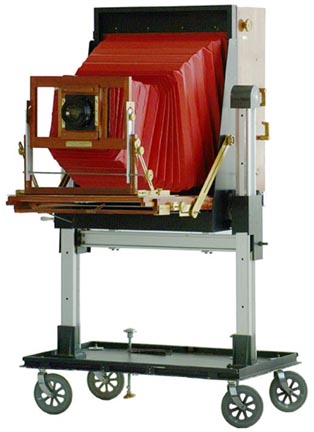
20x24

Monday, December 3, 2007

Collected Visions

When I was teaching, one of my favorite essays to use was Marianne Hirsch on postmemory. I liked the difficulty students seemed to have with it—they would grasp to certain parts and seemingly refuse to understand others (the section that describes the film Hate, for instance, always seemed to generate trouble).


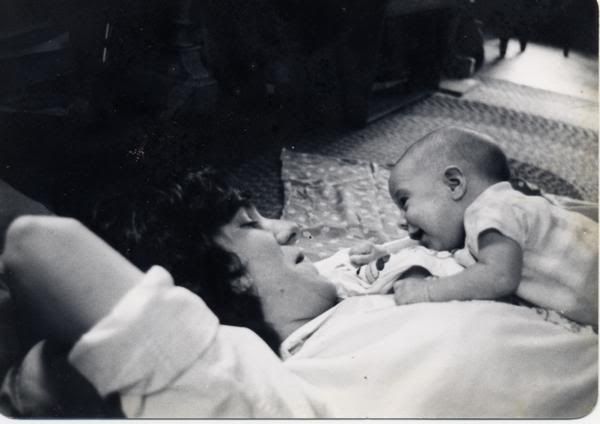
I asked my students, each semester, to contribute to Lorie Novak's formidable Collected Visions project. They could submit snapshots, if they liked, but the main thing I wanted was for them to utilize the database (of approximately 3,000 family photographs) to create essays. It was my hope that this project would help them suss out the concept of postmemory. Sometimes it worked; sometimes it didn't.

So, I have two aims in posting this. One is to spread the word about Collected Visions. The other is to keep it here, next to other images, ideas, resources, etc., that will help me with the prosthetic memory project.

Photo Sharing and Video Hosting at Photobucket