
The past several days, I've had the distinct feeling of being mute. I feel as though I'm giving stillbirth to words.
I haven't written anything about which I'm content in longer than I can remember.
I need to be bolstered up and ordered by something, but I'm not sure what that might be.
Showing posts with label birds. Show all posts
Showing posts with label birds. Show all posts
Wednesday, March 4, 2009
Mute and hardly active

Saturday, January 10, 2009
Pigeon-finity...
Things I have learned this week:

- reading about boredom does not always create enough intellectual stimulation to stave off boredom (Heidegger, I'm talking to you)
- once you start researching boredom, you will never be able to use the word "interesting" without being self-critical
- pigeons are commuters
- Wordpress is really, really annoying
Thursday, May 8, 2008
"I can't get out."

I've been seeing these darlings all over this spring. When I walk down the block each morning to my car, they hop along side me, the social little things. (Of course, this perceived sociability could have something to do with my neighbor's newly seeded lawn...)

the birthday card the beautiful and talented Jillian Vento made me, called "Still Lost Pet Bird Finds a Crown"
If you read these musings regularly, you may remember Still Lost Pet Bird. I still think about her everyday. I thought about her this morning as I was reading Laurence Sterne's A Sentimental Journey:
I was interrupted in the heyday of this soliloquy, with a voice which I took to be of a child, which complained "it could not get out."—I look'd up and down the passage, and seeing neither man, woman, nor child, I went out without further attention.
In my return back through the passage, I heard the same words repeated twice over; and looking up, I saw it was a starling hung in a little cage—"I can't get out—I can't get out," said the starling.
I stood looking at the bird: and to every person who came through the passage it ran fluttering to the side towards which they approach'd it, with the same lamentation of its captivity—"I can't get out," said the starling—God help thee! said I—but I'll let thee out, cost what it will; so I turned about the cage to get to the door; it was twisted and double twisted so fast with wire, there was no getting it open without pulling the cage to pieces—I took both hands to it.
The bird flew to the place where I was attempting his deliverance, and thrusting his head through the trellis, pressed his breast against it, as if impatient—I fear, poor creature! said I, I cannot set thee at liberty—"No," said the starling—"I can't get out—I can't get out," said the starling.

Sunday, March 16, 2008
you can't take it with you
I do not have great chronological mastery of my memories. They tend to flash before me like so many birds. Sometimes they sit still, wait long enough for me to take a good look, to take in the tawny spectrum of their feathers. Other times they undulate in the sky - their swarming dance not unlike the pull and recoil of algae in a tidal pool. Still other times they dart across my field of vision so fast they are the merest suggestion of a being.
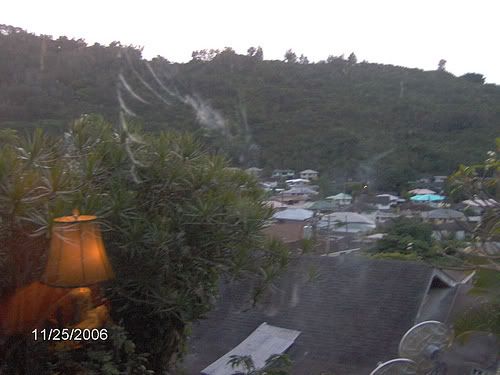
"A beautiful subject can be the object of rueful feelings, because it has aged or decayed or no longer exists. All photographs are memento mori. To take a photograph is to participate in another person's (or thing's) mortality, vulnerability, mutability. Precisely by slicing out this moment and freezing it, all photographs testify to time's relentless melt." - Susan Sontag, On Photography
The photograph I've placed above was taken by a woman who was on her last visit to her dying mother. In the same batch, she has posted the last photograph she took of her mother. Her mother is in a hospital bed, in the photo, with tubes - oxygen and something intravenous. She looks frail and tired (as one would). The woman notes, in her caption, that her mother was at an excellent nursing home, where she was pampered.
About a month later, after her mother had died, the woman returned to Honolulu with her brother. They climbed to the top of the highest hill in the city, where their parents wished to scattered, and took this photograph of the site:
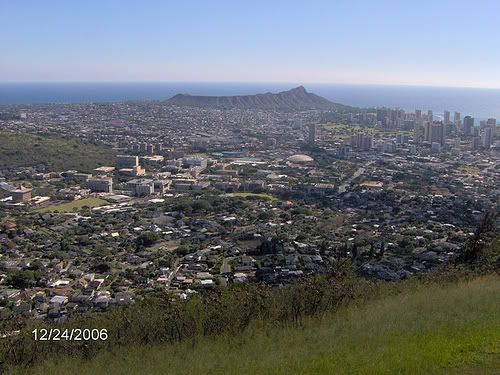
I think there was a pretty significant paradigmatic shift that came with the popularization of photography. It seems to me that we know better how to negotiate our experiences through this medium.
I remember three things mainly about my grandfather's funeral: (1) it was surprising to see my father, my uncle Freddy (from the other side of the family), and Bob Cook standing together; (2) the room smelled musty and I was concerned that I would sneeze inappropriately; and (3) my grandfather's hands were harder than I'd expected and cold. I don't know if I would feel differently now about his hands if I had photographed him, but my impulse is to guess that I would, to guess that the thing would grant me aesthetic distance.
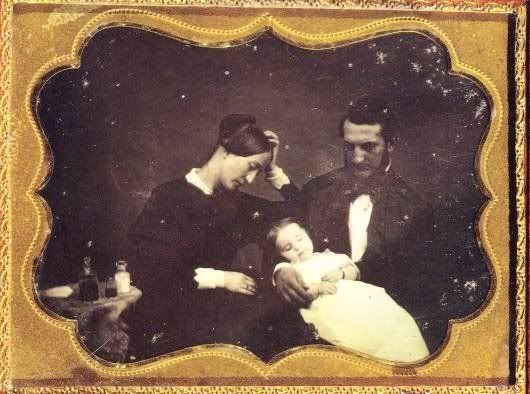

"A beautiful subject can be the object of rueful feelings, because it has aged or decayed or no longer exists. All photographs are memento mori. To take a photograph is to participate in another person's (or thing's) mortality, vulnerability, mutability. Precisely by slicing out this moment and freezing it, all photographs testify to time's relentless melt." - Susan Sontag, On Photography
The photograph I've placed above was taken by a woman who was on her last visit to her dying mother. In the same batch, she has posted the last photograph she took of her mother. Her mother is in a hospital bed, in the photo, with tubes - oxygen and something intravenous. She looks frail and tired (as one would). The woman notes, in her caption, that her mother was at an excellent nursing home, where she was pampered.
About a month later, after her mother had died, the woman returned to Honolulu with her brother. They climbed to the top of the highest hill in the city, where their parents wished to scattered, and took this photograph of the site:

I think there was a pretty significant paradigmatic shift that came with the popularization of photography. It seems to me that we know better how to negotiate our experiences through this medium.
I remember three things mainly about my grandfather's funeral: (1) it was surprising to see my father, my uncle Freddy (from the other side of the family), and Bob Cook standing together; (2) the room smelled musty and I was concerned that I would sneeze inappropriately; and (3) my grandfather's hands were harder than I'd expected and cold. I don't know if I would feel differently now about his hands if I had photographed him, but my impulse is to guess that I would, to guess that the thing would grant me aesthetic distance.

• • •
Later on the day of my grandfather's funeral we sat on my aunt's porch and Bob Cook gave my little cousin Robby things to throw into the chiminea - scraps of paper, receipts, a soda can, a hard boiled egg.
Tuesday, February 26, 2008
"a sparrow at night don't mean it's morning."
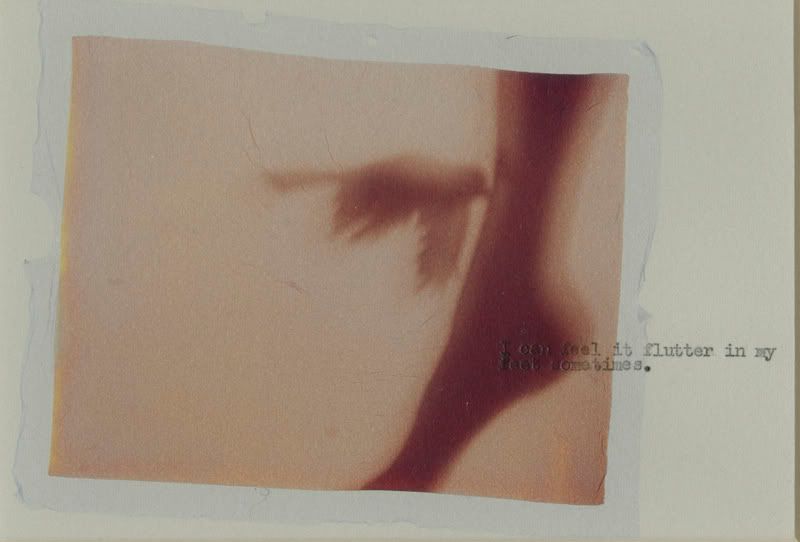
by Jillian Vento
My parents’ house, the same house in which I grew up, is situated half way up the highest hill in our town. We lived in the midst of a dense deciduous forest. Patrick and I would play in the woods or down the hill in the stream that went beneath (and sometimes flooded above) our driveway.
The driveway itself is an old Town road. Woodland cuts North up through the trees and across the hill on which my house sits, snug amongst the Sugar Maples. The old Woodland continues beyond my house, gets lost and obscured in the woods a bit, and then emerges as an active, if unpaved road several miles out.
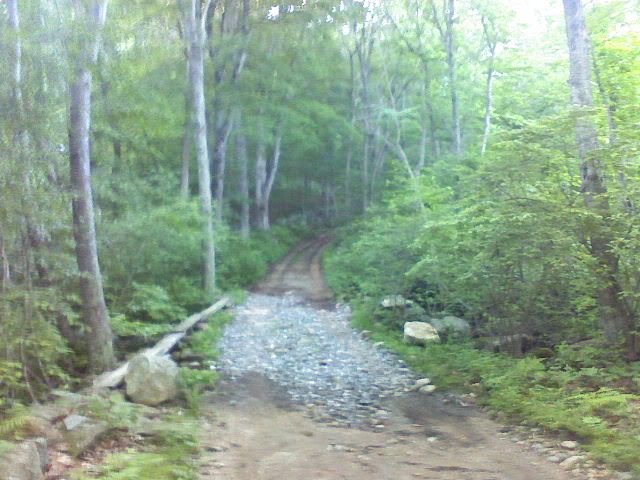
When we were young, Pat and I (and, later, Nora) were sent outside a fair amount. We would meander our way through the woods, to the swamp or to the stream. We would wander up the hill to the cliffs. After some time, we would hear it: the simulated owl’s hoot that one parent or other would let out, expecting us to echo back. It was our honing mechanism.
The woods are filled with sounds. It’s a tightly packed euphony: trees that creak in winter under the weight of ice or snow, animals that scamper through last autumn’s dead leaves, wind through trees and over rocks, water carving its way down the hill, and the owls.
Even as a child I was enamored with the owls. When, in Twin Peaks, various characters warn the “the owls are not what they seem,” rather than feeling alarmed by that kind of sylvan scopophilia, I felt comforted by the idea that these birds could be nocturnal sentinels.
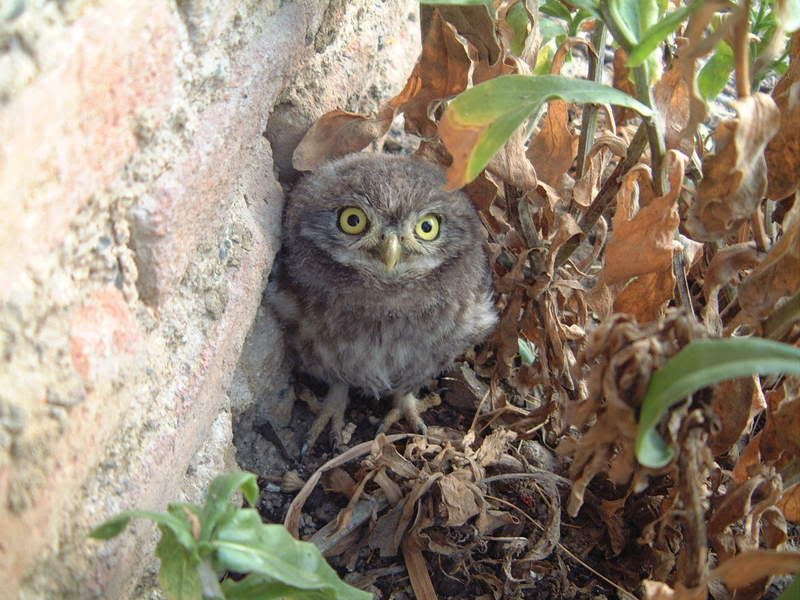
One of my father’s favorite tasks is filling the bird feeders in the yard and off the porch. After he’s funneled the feed into the containers – some of them wooden, some of them copper and glass, some plastic and wire mesh – he stands back on the porch and surveys the field. He points out the woodpeckers, the blue jays, the sparrows. He pelts the occasional squirrel with a snowball.
My father protects those precious creatures. I mean precious in the sense Catholics mean it when they talk about the precious body or the precious blood. I mean that material form that takes on the qualities of the miraculous. Birds.
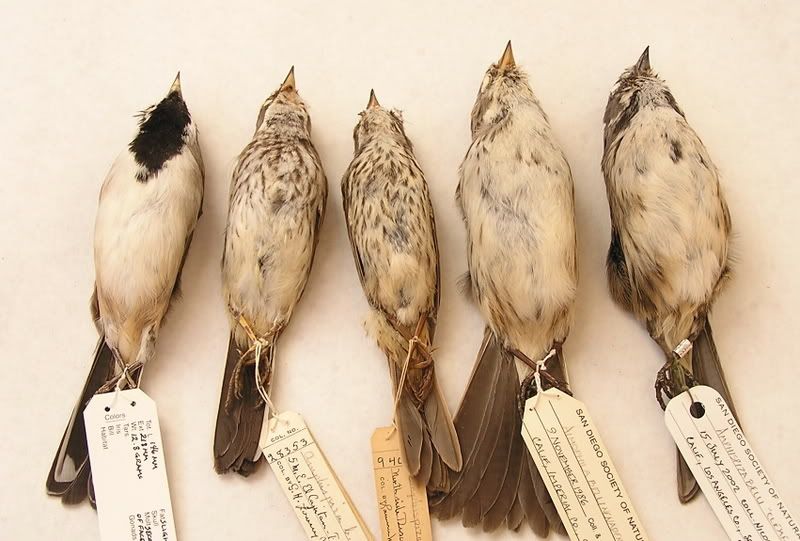
Impossibly crossed feet. Impossibly hollow bones. Impossibly delicate babies.
I suppose part of it started when we lived in the house on Storrs Road, by the lake. It was on the second floor of an early 19th-century farm house that had been converted in the 70s to apartments. We had a small porch and long stairway that we lined with flowers (a magnificent fuchsia that year) and tomatoes and basil. The sparrow built her nest in the eve of the small overhang that covered our doorway. In the mornings and evenings we would avoid opening the door very much at all so as not to scare her off. You would stand in the kitchen and elicit in me peal upon peal of laughter by imitating the babies.
It's still too sad to represent properly. After several days and no plaintive cries from the nest, I asked you to look in, to bury them somewhere. I couldn't even stand to look. And you did it for me.
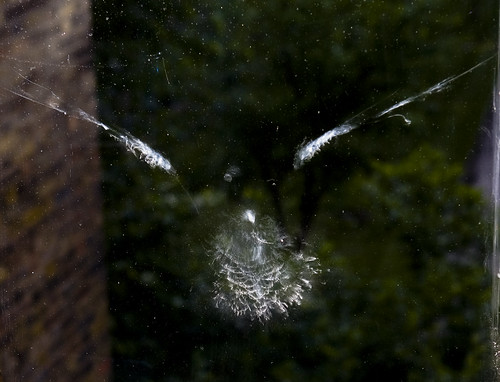
I'm working up to something, here, but I can't just yet.
Subscribe to:
Posts (Atom)
