Site Meter Peculiar Susceptibility

Friday, April 4, 2008

sometimes it's just hard for words


by Katie Taylor

It's been happening for about a month now, this disconcerting sense that I am losing my easy grasp on whatever fibers those are that connect my intended meaning with the expression of it that follows.

I am constantly doubting that anything I say or write makes sense. Emails and conversations are littered with "Does that make sense?" and "I'm not expressing it well" and "Do you understand what I'm trying to say?" And people respond "yes" or "no" or "I think so," but it doesn't leave me feeling any more assured that I've felted language and meaning together properly.


And another disconnection: I know this happens—I understand it intellectually. I've written about it, language dissolving when experience bursts its seams. Think about Toni Morrison in those school primer passages in The Bluest Eye. Think about Finnegan's Wake or Septimus Smith. Think about The New York Trilogy.

But I find more and more as I accumulate experiences that intellectual understanding does not prepare you for experiencing things during whatever present in which they occur. They're separate forms of knowing.


by Fay Ku

I was reminded the other day of the concept of the un-thought known. It's a term from psychoanalysis (if I understand it correctly) that refers to the knowledge a child accumulates that is never consciously given to her and that she doesn't knowingly receive. It's not a kind of knowledge that we can take stock of and it functions extralingually.

I keep hoping that maybe knowledge works a bit like a hybrid engine, with one part kicking in for the other when necessary. Maybe my un-thought known is picking up the slack these days.

Wednesday, March 26, 2008

boundaries

Growing up as I did, the daughter of a surveyor, it is perhaps not surprising that I regularly wonder about borders and boundaries.

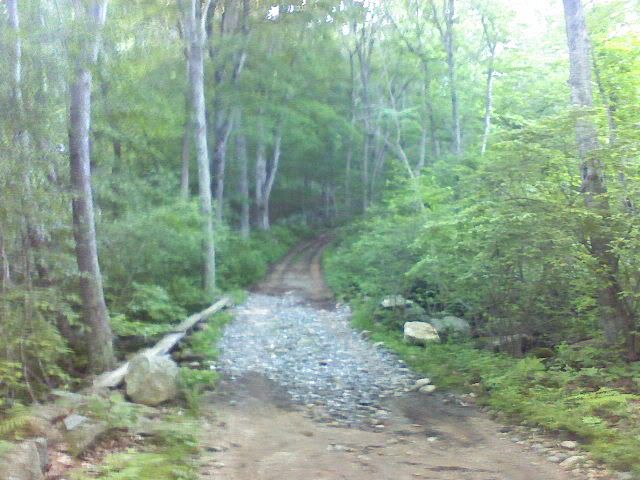
The forest in which Nora, Pat, and I grew up is filled with surprising stone walls - stone walls where no foundation or house is nearby, stone walls that the Joshua's Trust trails now traverse.

Photobucket

I've had debates in suburban backyards about whether or not property boundaries are real (nb. do not try to have this argument with an existentialist, even one well-acquainted with stone walls and hedgerows, unless you are prepared to give up a bit flustered).

In my days teaching daycare, I enjoyed watching the various methods 3-year-olds have for negotiating boundaries - rule bending, side-stepping, and loop-hole-finding at its best.

These days, I've been wondering about where the self starts and stops. Sometimes I feel the fixed perimeter of this corporeal husk so palpably. I feel amazed that I don't burst over the seams of my body. Other times, it seems comforting to reject the "hereness" of our bodies.

What keeps one fragile force from another? That's what I kept wondering last night as I was watching Caribou at the Iron Horse. It was easily the best concert I've seen this year and, as they sat, drum kit to drum kit, face to face, I couldn't help but marvel over all those sounds - those overlapping indexes of self - and where it all starts and where it all stops.

Tuesday, March 18, 2008

the hectares of my heart

I look at this picture of my mother and I think she is probably the most beautiful woman I've ever seen.

my mother pregnant with me

Today my mother has officially spent half her life as a mother. She was 29. She had lived in Hawaii and Tucson and sundry locations across the Northeast. She had been married and divorced and married again. She and my father owned a house in the middle of a forest they loved. She had found a career in a field that utilized her degree (granted, that field did not and does not pay a living wage). She had and has great legs.

It's hard not to measure oneself against that.

Photobucket

Sunday, March 16, 2008

you can't take it with you

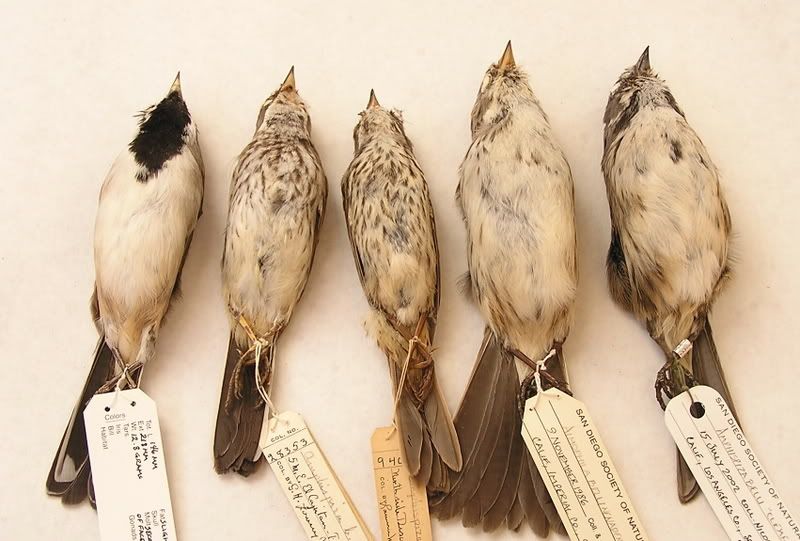
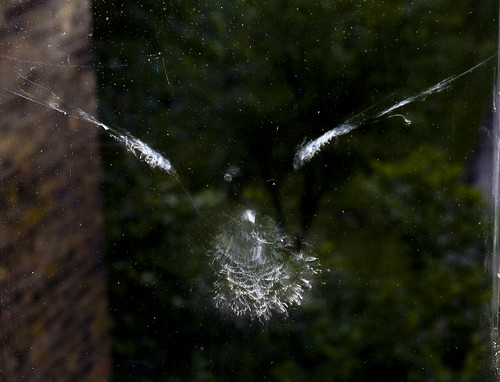
I do not have great chronological mastery of my memories. They tend to flash before me like so many birds. Sometimes they sit still, wait long enough for me to take a good look, to take in the tawny spectrum of their feathers. Other times they undulate in the sky - their swarming dance not unlike the pull and recoil of algae in a tidal pool. Still other times they dart across my field of vision so fast they are the merest suggestion of a being.

bird impression

"A beautiful subject can be the object of rueful feelings, because it has aged or decayed or no longer exists. All photographs are memento mori. To take a photograph is to participate in another person's (or thing's) mortality, vulnerability, mutability. Precisely by slicing out this moment and freezing it, all photographs testify to time's relentless melt." - Susan Sontag, On Photography

The photograph I've placed above was taken by a woman who was on her last visit to her dying mother. In the same batch, she has posted the last photograph she took of her mother. Her mother is in a hospital bed, in the photo, with tubes - oxygen and something intravenous. She looks frail and tired (as one would). The woman notes, in her caption, that her mother was at an excellent nursing home, where she was pampered.

About a month later, after her mother had died, the woman returned to Honolulu with her brother. They climbed to the top of the highest hill in the city, where their parents wished to scattered, and took this photograph of the site:

where their ashes will go

I think there was a pretty significant paradigmatic shift that came with the popularization of photography. It seems to me that we know better how to negotiate our experiences through this medium.


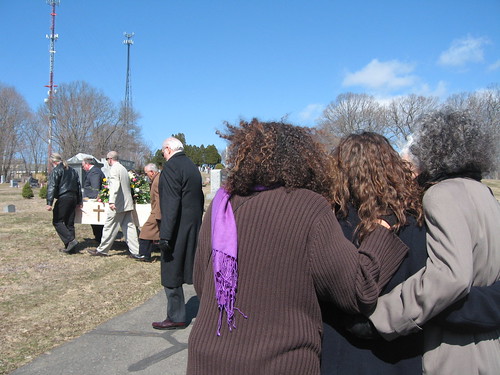
I remember three things mainly about my grandfather's funeral: (1) it was surprising to see my father, my uncle Freddy (from the other side of the family), and Bob Cook standing together; (2) the room smelled musty and I was concerned that I would sneeze inappropriately; and (3) my grandfather's hands were harder than I'd expected and cold. I don't know if I would feel differently now about his hands if I had photographed him, but my impulse is to guess that I would, to guess that the thing would grant me aesthetic distance.

Photobucket

• • •

Later on the day of my grandfather's funeral we sat on my aunt's porch and Bob Cook gave my little cousin Robby things to throw into the chiminea - scraps of paper, receipts, a soda can, a hard boiled egg.

Tuesday, February 26, 2008

"a sparrow at night don't mean it's morning."


by Jillian Vento

My parents’ house, the same house in which I grew up, is situated half way up the highest hill in our town. We lived in the midst of a dense deciduous forest. Patrick and I would play in the woods or down the hill in the stream that went beneath (and sometimes flooded above) our driveway.

The driveway itself is an old Town road. Woodland cuts North up through the trees and across the hill on which my house sits, snug amongst the Sugar Maples. The old Woodland continues beyond my house, gets lost and obscured in the woods a bit, and then emerges as an active, if unpaved road several miles out.


When we were young, Pat and I (and, later, Nora) were sent outside a fair amount. We would meander our way through the woods, to the swamp or to the stream. We would wander up the hill to the cliffs. After some time, we would hear it: the simulated owl’s hoot that one parent or other would let out, expecting us to echo back. It was our honing mechanism.

The woods are filled with sounds. It’s a tightly packed euphony: trees that creak in winter under the weight of ice or snow, animals that scamper through last autumn’s dead leaves, wind through trees and over rocks, water carving its way down the hill, and the owls.

Even as a child I was enamored with the owls. When, in Twin Peaks, various characters warn the “the owls are not what they seem,” rather than feeling alarmed by that kind of sylvan scopophilia, I felt comforted by the idea that these birds could be nocturnal sentinels.


One of my father’s favorite tasks is filling the bird feeders in the yard and off the porch. After he’s funneled the feed into the containers – some of them wooden, some of them copper and glass, some plastic and wire mesh – he stands back on the porch and surveys the field. He points out the woodpeckers, the blue jays, the sparrows. He pelts the occasional squirrel with a snowball.

My father protects those precious creatures. I mean precious in the sense Catholics mean it when they talk about the precious body or the precious blood. I mean that material form that takes on the qualities of the miraculous. Birds.


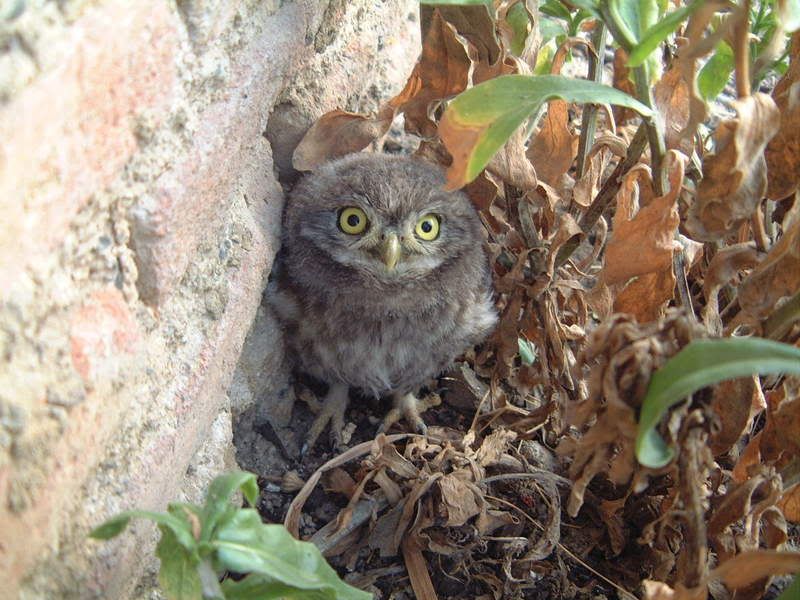
Impossibly crossed feet. Impossibly hollow bones. Impossibly delicate babies.

I suppose part of it started when we lived in the house on Storrs Road, by the lake. It was on the second floor of an early 19th-century farm house that had been converted in the 70s to apartments. We had a small porch and long stairway that we lined with flowers (a magnificent fuchsia that year) and tomatoes and basil. The sparrow built her nest in the eve of the small overhang that covered our doorway. In the mornings and evenings we would avoid opening the door very much at all so as not to scare her off. You would stand in the kitchen and elicit in me peal upon peal of laughter by imitating the babies.

It's still too sad to represent properly. After several days and no plaintive cries from the nest, I asked you to look in, to bury them somewhere. I couldn't even stand to look. And you did it for me.


I'm working up to something, here, but I can't just yet.

Saturday, February 16, 2008

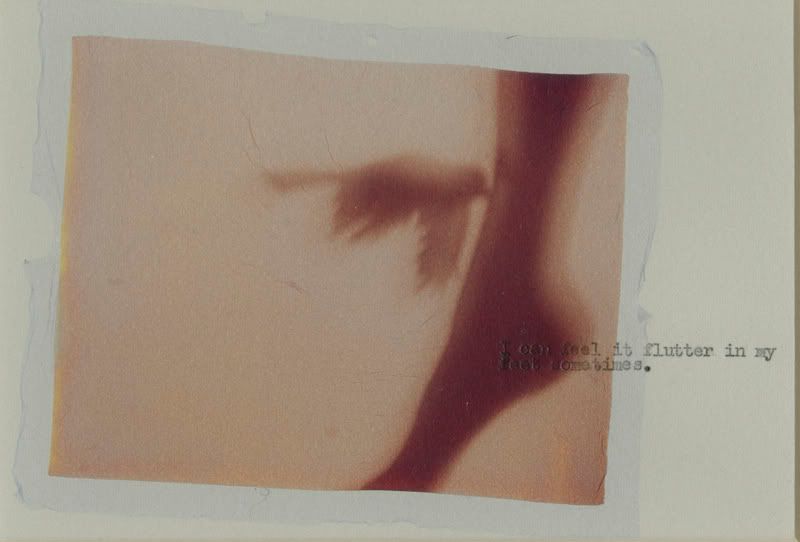
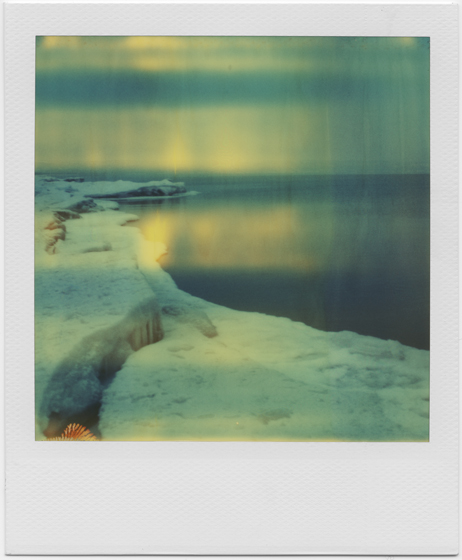
Polaroid RIP


I never owned Polaroid camera. We had other things at my parents' house: a cute and dear brownie camera, a nice 35mm Canon, even sundry cheap point and clicks for my siblings and me. But there was something about Polaroids that didn't suit my mother's photographic inclinations. She's never said as much, but I think there was something she considered crass about Polaroids - their indulgence of instant gratification (although, I think what actually happens here is more subtle and complicated...), their room for captions, their smell, even.

But I liked them.
I liked the smell (my mother and I often differed in our olfactory judgments - she wondered how on earth I could possibly like the smell of gasoline, for instance). I liked the tension between quick gratification and delayed pleasure that those moments spent waiting for the image to emerge engendered. I liked the look-shake-look pacing of it all.

And I liked the kinder, more impressionistic image that resulted. This could have had something to do with my poor eyesight. I still remember how alarming it was when I first got glasses (at 7) and the world became sharp. All of it turned promptly from soft and indistinct to sharp - the things I saw and the headaches I had. Trees suddenly had individual leaves; signs had words on them; sounds in the woods had animals dashing. Still, this vividness sometimes seemed to me to be utterly overwhelming. In the woods, I would sometimes take my glasses off and rely on the suggested messages of my poor eyesight, rather than the firm dictations of the world through my glasses. When I could see the disappointed expression of a parent, I would take them off and a furrowed brow would blur. Maybe there was something appealing about the vagueness of Polaroids.


by director Andrei Tarkovsky

There's a lot about Polaroids that make them poignant. In their popular form, they're one-of-a-kind. They're not little gems in the same way Daguerreotypes are, but they are singular. Even when you can peel back the jacket of a Polaroid and press and press and press, it fades a little each time, or you move it as you press and it smudges. Or the paper wrinkles. At any rate, there are endless opportunities for punctum. They change in your hands. They're used as tests for proper photos (I can't help but feel an affinity with anything so used for practice).


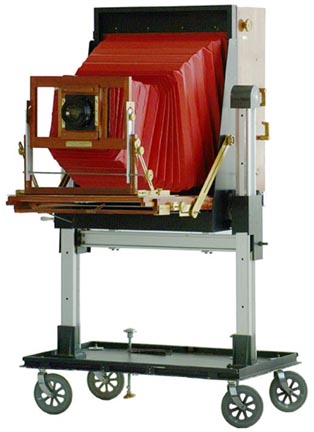
20x24

Tuesday, January 22, 2008

What I can remember of it

The first figure skating tests I proctored were in UConn's old ice rink. It was exposed to the elements except for a boat-shaped roof and metal bleachers that were not, on that day, filled with the people that might have done better to block the wind a bit.

Photobucket

I had a knack for it - teaching children how to skate - because I worked hard (very hard) for every skill or jump or edge or spin that I mastered. I taught in those days in exchange for ice time. I spent a couple hours with the very little ones - toddlers, usually - who were always wrapped in bundle upon bundle.

The very first thing we taught them was how to fall.

Earlier this month, I stopped home for my brother's birthday (and for Jane Austen on PBS). I was standing at the woodstove with the dog and my mother said, in an off-handed way, "Chris Bowman died."

They called him Bowman the Showman:


When Chris Bowman skated this program, which is still a joy to watch, I was actively training as a figure skater. Very actively. Everyday actively. Going home and training more actively. Reading USFSA rule books actively.

I would read for homework standing with the arches of my feet pressed against the base of the desk. I had bunk beds at the time. I slept on the top bunk so that, before I went to sleep each night, I could drape my spine over the edge until its bend would approximate 90 degrees.

It was in the early 90s that my mother and her friend Holly took me to see the Stars on Ice tour. Holly was the adventurous one of the three of us, convincing us to sneak down to some unoccupied third-row seats. She also convinced us to go backstage without passes.

At that point I was already almost my full height. (I grew fast and early and coaches were always muttering things like "You'd better hope you don't get any taller" or "drink some coffee - stop growing.") It was backstage, meeting these people that I realized how short they really are - and how doomed my already dubious skating aspirations were.

Photobucket

It was the edge of an era for skating. They were about to do away with the very practice that gave the sport its name:


I was not a showman. I loved figures. They played to my obsessive streak. (In case it's not clear from the clip, you're expected to skate exactly in the rut of your last run, presuming, of course that your last run was perfect. I spent hours and hours practicing this, establishing the muscle memory of a perfect arch.)

Despite my desire to be a showier, more physically adventurous skater, this is the program I remember best.
Torvill and Dean "Oscar Tango":

[Just a quick aside: how could you possibly think, as a commentator, that it was a good idea to yap through that program, which was so clearly about hearing blades on ice? Just let the Brits be postmodern.

The roof of the old UConn rink - now renovated into an ugly arena - gave the place strange acoustics. I knew all the boys who used to drive the zamboni, so they would let me on the ice at the end of the night, after it was cleaned for the next day. I would go out to the center, do a couple figures, and then stomp my blades. The whole place reverberated with the sound.]

You'd think, with all that practice falling, and with all that practice negotiating perfection, that life, now, that all of this would be easier.