Site Meter Peculiar Susceptibility

Saturday, August 30, 2008

wandering the narrows


I feel as though I have been wandering the Narrows for some time.


It was a weekend filled with seemingly obvious conjunctions of Nature and the mechanical.


It was hot and I felt as though I was adrift in the belly of some mechanical whale. Me, some little modern Pinocchio, some Jonah.

Sunday, August 17, 2008

"a feeling as infinite as an open accordion"


Rosario, 2004. By Margarida Correia

During my last several conversations with my mother, she has remarked that I must be feeling nostalgic lately. I've been asking her to tell me stories from when I was a child - whether it's a story of some friend who fell and got a concussion, or whether she remembers my brother and I ever fighting (she doesn't). I've been wanting to know those little particular histories.

I spent yesterday by myself, doing a variety of things that would seem to support her charge (although she wouldn't call it an accusation, I find that I respond to it with a degree of defensiveness).


I opened up and dusted off my clarinet for the first time in 13 years. I played for hours.


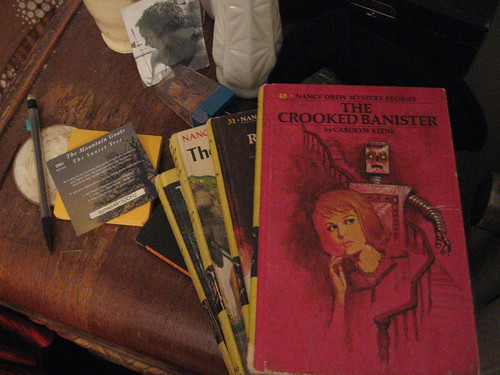
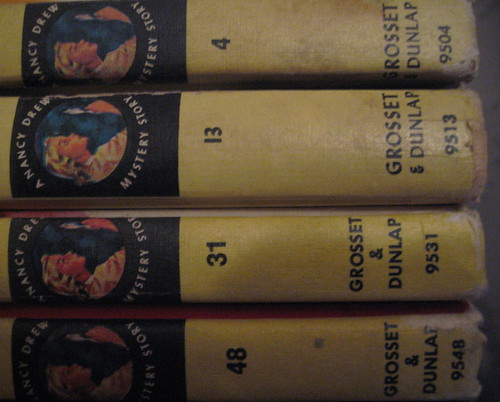
I went to the ArtSpace tag sale, where I discussed Nancy Drew with a small girl and her mother. The girl, in a manner entirely reminiscent of my own experiences of family tag sales, demanded of her mother "You're not selling those, are you?! You said that they were ours!"

I opened one of the books to find a scene I remember from when I was a child in which Nancy disguises herself by coloring her trademark blonde hair with mascara (successfully, if you can imagine such a thing!).


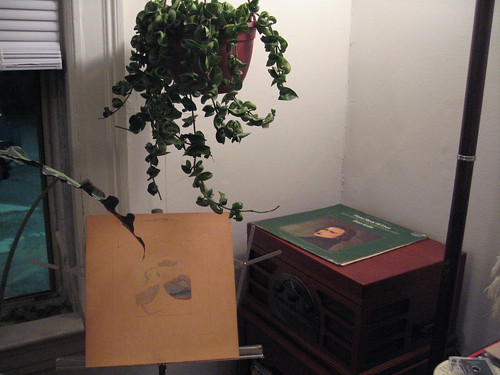
I went to Integrity 'n Music, one of my favorite places to visit, where I was treated to the always-impressive Jackie McLean Youth Jazz Orchestra. I found there, among other things, Court and Spark - an album that was woven firmly through the entirety of my first two decades. I sang it through twice - I've always liked the way my voice bends around those songs. It was a sweet and pleasant hour-and-a-half.

And yet, I'm not sure it's exactly nostalgia that spurns these activities. It's true that I'm seeking to solidify my experience in the present and I know I'm concerned (me with my imperfect memory) with having some kind of document of my days. But I think there is something more to my impulse than the desperate grasping for proof of existence.

In Svetlana Boym's formidable The Future of Nostalgia, she traces a history of the malady. Nostalgia came into existence during a paradigmatic shift that effected much of the world. In the 18th century - that period of constant exploration, rapid colonization, and concerted nation-building - people responded to the universalization of experience, of space, and of time (think of the popularization of clocks, of the systematization of map-making) with a keen longing for the particular. As Boym suggests, "Nostalgia, as a historical emotion, is a longing for that shrinking 'space of experience' that no longer fits the new horizon of expectations" (10).

Perhaps what I'm feeling is not nostalgia alone, but something akin to Kant's ideal melancholy - that which enables one to be particularly attuned to the dilemmas of life.


Then again, maybe I do just want another chance to be seven, to thumb my way through a card catalogue, and to be aware of those moments through which I pass.

Tuesday, August 12, 2008

"as the flames rose to her Roman nose"

Well, it's nothing like that summer I was 14 and we piled into some boy's car to watch So I Married an Axe Murderer at the Mansfield Drive-In.  That summer it was The Smiths and cut off jean shorts and little kids' tee-shirts and Manic Panic.  It was deciding to screw being tan for the first time.  It was cars filled with older friends and it was singing arias in the back seat.  It was mix tapes and humidity.


When you're 14 the colors that fill out your experiences are deeply saturated. When you're 14 this saturation is extended by a general oblivion to the world around you, so that, for instance, not knowing that you were going to the drive-in during the Perseid meteor shower and then seeing dozens of stars raining down, would probably result in you deeming the night to be among those that were your most magical.

But then, what's 14 for if not self-centered magic?


But tonight was good, too, in its own quasi-adult way. I worked late - till around 9; I went to the gym; I showered; I did the dishes. And then I packed up The Bear and walked down the block to the law school's soccer field. My block has an odd sort of mix of housing - there are longtime West End residents; there are wealthy, newly-arrived homeowners; there are the residents of the assisted living facility; there are people on Section 8; and there are renters (most of them law students). As I walked down the block, I noted one television, one unidentified ultraviolet liquid, four used mattresses, one stove, three adolescents getting the most out of the days before the curfew takes effect, two cats (not counting The Bear), and one couple sitting on their porch. I walked past the sublime Hartford Seminary and tromped out into the middle of the field. The grass was wet. I put The Bear down and stretched out, long on the wet earth.

And I waited.

And just when I had determined that there is probably too much light pollution in Hartford to watch a meteor shower, there it was - one perfect slash of the razor against the sky. And I loved it. And it made me gasp. And The Bear switched from purring to the little sound she makes when she's taking stock of her surroundings.

Wednesday, July 30, 2008

"we pass on // to another cellar, to another sliced wall / where poor utensils show / like rare objects in a museum"

It makes sense.  It makes sense if poetry makes sense to you.  Or maybe it makes sense if you've oriented yourself - deliberately - toward poetry.

The three poets to which I was most drawn as a girl were William Butler Yeats, Walt Whitman, and Anne Sexton. Because of the nature of my reading habits (pulling things from my parents' shelves and delving), I only read one book by each early on - the cheap penguin Irish writers paperback that one or the other parent bought somewhere along the way for 25 cents, the gorgeous illustrated edition of Leaves of Grass, and The Book of Folly.

Each of these, in their own way, has a propensity for layering things one upon another. Whitman, of course, layers himself on everyone else. Sexton layers herself upon herself:
It is waiting. / It is waiting. / Mr. Doppelgänger. My brother. My spouse. / Mr. Doppelgänger. My enemy. My lover. [from "The Other"]

[I've sat like this for as long as I can remember - one leg snaking around the other - my own skin pressing on my own skin, fast with pressure.]

And Yeats. Well, Yeats, with his famously widening gyre, does it most transparently, doesn't he?

I can't help but think that, having oriented myself toward this kind of layering, I am somehow primed to suss it out in my life. And yet, it doesn't give rise to any less wonder each time my life folds back onto itself, all overlapping and resignified. Lessons, people, opportunities (missed and present) serve themselves up again and again.

And my response - always - is that quickening clutch of throat and that almost immediate impulse to think of gyres, of palimpsests, of pentimento.

[The Hay Wain, by John Constable]

I suppose that's the nature of pentimento - you make a choice, repent, cover it up, but then it slowly reveals itself under the façade you established, however meticulously.

Monday, July 21, 2008

"location-notes and love calls"

When I read about the man who leapt over barricades on opening day of the Berlin Madame Tussauds' to tear off the head of the Hitler figure, the first thing I thought of was the woman during the Roman Empire who, locked away by her family because she was Christian, ate the icon that was in her chambers. Paint, splinters, gold leaf - she ate it in a fit of - of what? - significant longing? Fetishization? Faith?

Perhaps it happened or perhaps not.


I thought that we had been told of it in our Early Christian and Byzantine Art History class. Michelle and I took this course together as undergraduates with the estimable Jean Givens. Michelle has a more encyclopedic memory than anyone I have ever encountered since, so when she didn't recall that woman, locked away eating her icon, zealous in it, I was prepared to release the memory to construction.


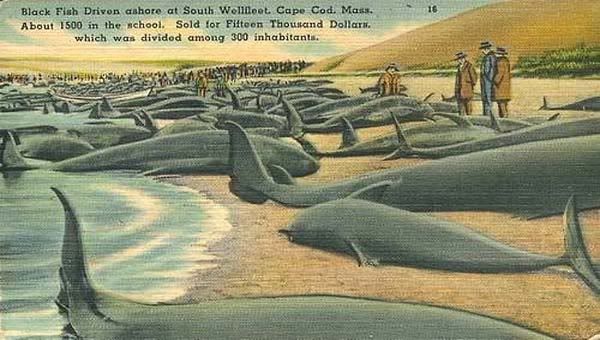
At Wellfleet last weekend, I was walking with my mother along the same beach we had visited when I was a toddler. She calls it my Kermit phase because there was a certain frog-shaped beanbag without which I was loathe to go anywhere at all (including into the Atlantic Ocean, freakish or not!). Walking there, feet bare and legs sea-slicked from the kicking tide, I asked her if she remembered the whales that stranded at Wellfleet when I was a girl.

She didn't, not particularly, and I started to question my memory again. For her, the first thing she thinks of when someone mentions Wellfleet is that trip we took, she and I together on the bus. For me, I think of the whales and how I heard, somewhere along the way, that rescue workers touch them near the big, inky eye to see how close to death they are.


When my father was a boy, they beached here, too, fifty of them at once.

We stood there together, dad and I, on the deck of the cabin he had visited since he was a boy. We took turns with Grandpa's binoculars. I insisted that, in Grandpa's honor, we always bow our heads through the strap before looking at the boats. "Brown-nose," my father said, but I knew he appreciated that I knew the way Grandpa would have liked things, just so.

Wednesday, July 16, 2008

so much depends on synapses, on sea slugs

It's impossible to start a poem with that phrase anymore.


In the 1950s, at Hartford Hospital (the site - decades later - of my siblings' births) Dr. Scoville made an accidental discovery about memory. He was trying to curb a patient's seizures. This, from Lauren Slater's Opening Skinner's Box:
Based on this last assumption [that memory was diffuse, without locale, scattered like widely sown seed over the whole rind of the cortex], Scoville had no hesitation about removing Henry's hippocampus. The operating room was cool. Henry lay awake on the steel table. Because there are no nerves in the brain, such surgery was performed with the patient completely conscious, only a local anesthetic to numb the skin of the scalp. Swoosh went the shot of lidocaine. A moment laster Henry must have seen Scoville coming at him with his hand-cranked drill, and then two holes were bored above each of his open eyes, and into these holes Scoville inserted a small spatula, with which he jacked up Henry's frontal lobes.

The operating room was quiet. Nurse, hand me this. Nurse, hand me that. But otherwise, no sound. Scoville was looking into Henry. He was looking under the hood of Henry's brain, and how beautiful it was beneath the cortical coral reef, in the brain's interior capsules, where pyramidal cells are shaped like hyacinth, in complex cones, where neurons are tiny but dense. Into this nether region Scoville now inserted a silver straw. Scoville slowly threaded the silver straw deep into Henry's pulsing brain, and then - there - he suctioned out the pink-gray seahorse shape on either side, the entire hippocampus now gone. Inside Henry's head, a great gap appeared, a ragged hole where something once lived.

What did Henry feel as Scoville sucked out his hippocampus? He was, after all, wide awake, thoroughly alert, and the hippocampus, although no one knew it at the time, is the seat of many of our memories. Did Henry feel his past leave him in a single suck? Did he feel the entrance of forgetfulness, like a cold thing coming in or was it more a sensation of sliding: your lover, your qualms, the cats calling beneath the porch in summer - all dropping down into nothing?

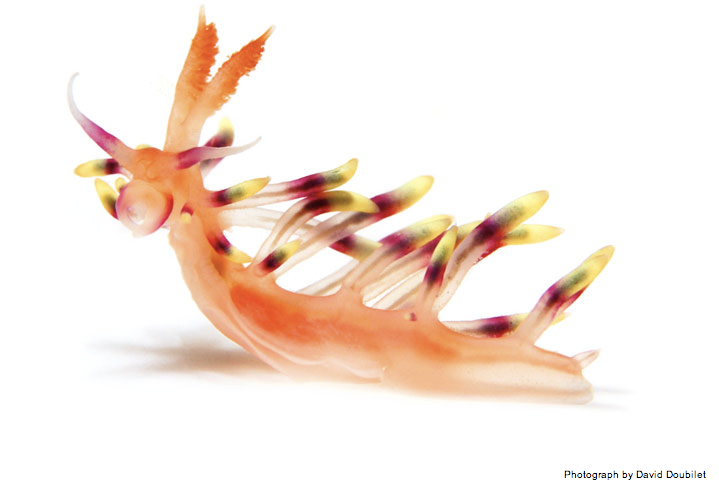
It was this accident that gave rise to the experiment on sea slugs through which we learned about the work synapses do for us.

One of the first phrases I associate with moving to Hartford is "build your synapses." When Robyn and I lived together, we would occasionally take meandering drives and learn new paths through Parkville and Frog Hollow and Asylum Hill. This activity was something she called "building synapses."


The other day, I withdrew from whatever social engagement I had arranged (a bad habit of mine) and sludged through some old vhs tapes to find a film I hadn't watched recently. I used To Catch a Thief as a comfort film for years - if I was sick or sad or lonely, it was one of my standards, like something you hum to yourself to quell your nerves.

I let it play through. When the 1994 World Cup footage I had taped over came on, I let that play, too.

There was something comforting about the sounds of it. I let it play and it let its soundtrack waft through my little house, heretofore unfamiliar with the fragmentary phrase construction of sportscasters.

Bits of memories came back to me about that tournament: that red-headed US player; their horrible uniforms; my dad's temporarily reassigned attention from baseball to soccer that summer; that the US team did better than people had anticipated.

And then - did I remember this or did I return to a spot vacant of particulars and inscribe a memory there - I read about Andrés Escobar and it was familiar and I felt, for a moment, the fascinated repulsion of an adolescent. It was easy to feel things in high contrast then, easy to slough off complexities.


Yes - it was this very game over which I taped a Hitchcock movie. This goal is covered up, leaving only muttered half-sentences of the end of the game. Would the sports casters have known? How eerie to watch this footage knowing what would follow, knowing that Escobar had, in a way, set into action a series of events that would give narrative structure to his life. It was rent, suddenly, from the complexities and undefinables of any-life and thrust into narrative significance - something like sea slugs, significant for the meaning we have plied from them after the experiments.

Tuesday, July 8, 2008

Snag Breac is ainm dom.

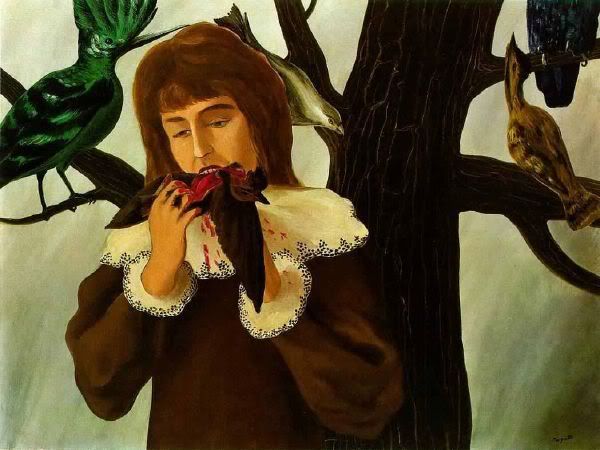
I've been dreaming of birds most nights.


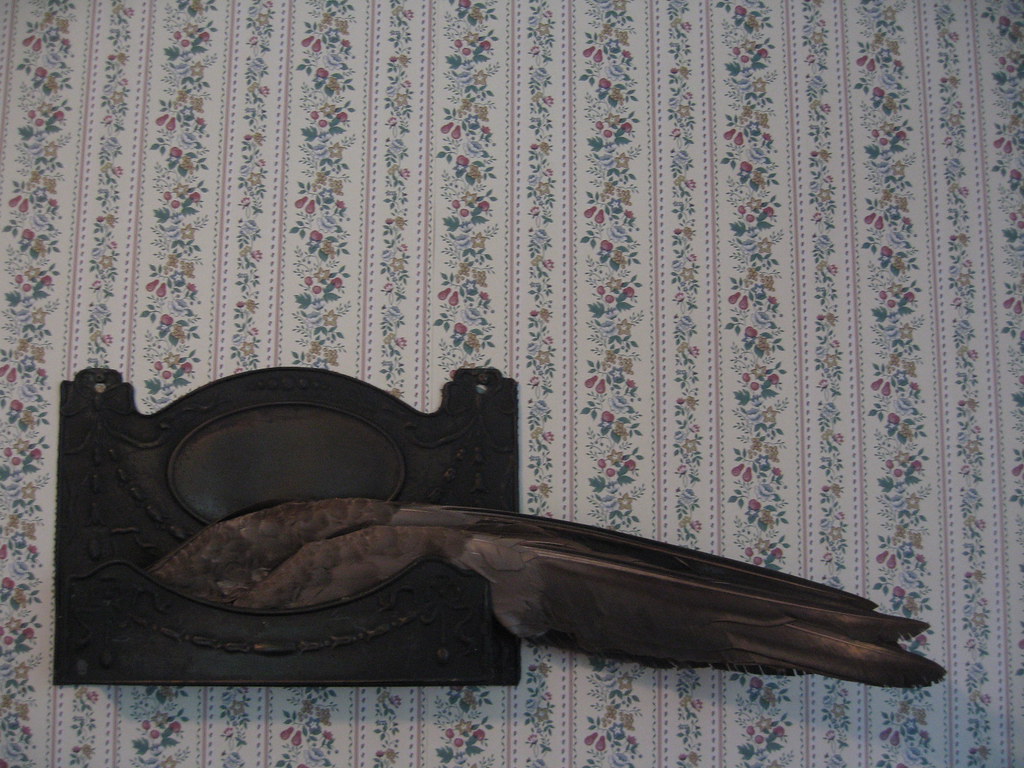
Last night it was that I picked this up and unfurled and refolded it again and again. It was white in the dream.

The night before - I fully acknowledge that this is grandiose, but when if not in dreams can we be grandiose, eh? - I dreamed that I discovered a new kind of falcon.

Don't laugh.

It was a peacock falcon and it was beautiful.


I willed myself into dreaming a gannet's plunge in the early hours of the morning.

I dreamed I protected sundry kittens and the puppies of lost friends from eagles.


I dreamed I was on my back, again, shirt damp from the spongy ground that surrounds the foundation of L. M. Montgomery's house, after I had retreated from the dives this bird's mother took at my head.