Site Meter Peculiar Susceptibility

Sunday, May 18, 2008

heft and hold shut your eye

Something changed for me the first time I looked at my world through a video camera. I've never been particularly good at remembering exactly when things happened. Sometimes I can piece it together based on cornerstones (many events in my life, for instance, are divided between Before Nora and After Nora), but really my memories are all kind of conglomerated.

I think this is partly why things like museums, archives, and libraries enticed me from a pretty early age - this notion of documenting things to tell stories to others, yes, but to your later self seemed like a good prosthesis to me.

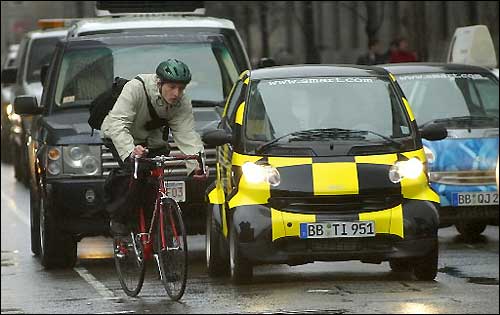
It was my friend Sarah's dad who taught me first how to use a video camera. Cameras then (circa 1985) were heavy. It wasn't the easy eight ounces of metal and circuits and cables that comprise today's digital cameras—it was still the age of the Big. In the mid-eighties one wanted a ghetto blaster, not something called a "nano." It was Cadillacs and Jeeps, not smart cars and mini coopers. No. These things required a bit of muscle and a certain grasp on the skill of stability.

From a very young age, I watched classic movies, those films of the 30s, 40s, and 50s that some how or other always ended up telling the story of how to be a woman: when to demure, what contexts in which one should not wear one's gabardine, how to serve a Manhattan.


I can only imagine it was from one f these films that I got it into my head to walk across and back the room with Webster's Collegiate Dictionary on the crown of my head. I usually took some kind of a teetering, tentative sort of a path across the floor, arms never coming to a complete rest at my sides before they would leap back up to the edges of the book. In retrospect, it probably wasn't the best volume to have selected: it was heavy, thick, hard-covered, and, most importantly, its binding was broken, which made it slide around unreliable, some Buster Keaton spoof. But, at the time, it was the choice; I wanted desperately for it to lend a certain gravitas to the activity. You see, I was earnest even then. I was very keen to be taken seriously.


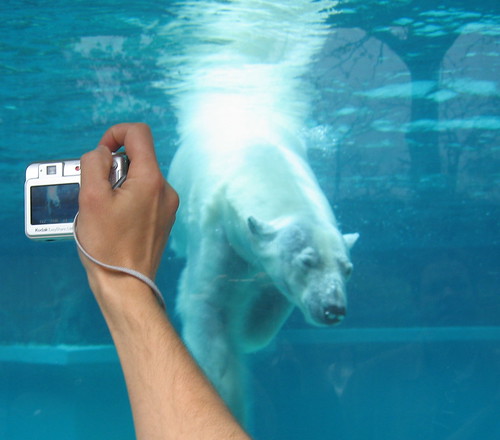
So, I had some degree of practice at stability. Nonetheless, video cameras then were heavy and unwieldy. You had to heft them up onto one shoulder and hold your neck just so, pressing one eye shut and the other to the viewfinder. It was a lot of coordination for a 6-year-old to manage.

Bob Cook was a natural teacher, storyteller, and community builder. These roles are perfectly exemplified in the way he taught me to use a camera. It was a method of connecting with people (could he tell how shy I was?) that seemed easier than holding a conversation. It was an initiation to and well-defined role within a group (documenter), a role that he often gave to any newcomers we happened upon. It was a way to approach our lives with a narrative orientation.

I've been recording things more these days. Clips are short (a drawback of digital recording) since I don't have an external hard drive and the quality is poor, but I have wanted keenly since Bob's death to make a better record of my days.

Here's Patrick at Real Art Ways the other night:


Here are the sounds of the majority of the spring evenings of my life:

Thursday, May 8, 2008

"I can't get out."


I've been seeing these darlings all over this spring.  When I walk down the block each morning to my car, they hop along side me, the social little things.  (Of course, this perceived sociability could have something to do with my neighbor's newly seeded lawn...)

still lost pet bird finds a crown
the birthday card the beautiful and talented Jillian Vento made me, called "Still Lost Pet Bird Finds a Crown"

If you read these musings regularly, you may remember Still Lost Pet Bird. I still think about her everyday. I thought about her this morning as I was reading Laurence Sterne's A Sentimental Journey:

I was interrupted in the heyday of this soliloquy, with a voice which I took to be of a child, which complained "it could not get out."—I look'd up and down the passage, and seeing neither man, woman, nor child, I went out without further attention.

In my return back through the passage, I heard the same words repeated twice over; and looking up, I saw it was a starling hung in a little cage—"I can't get out—I can't get out," said the starling.

I stood looking at the bird: and to every person who came through the passage it ran fluttering to the side towards which they approach'd it, with the same lamentation of its captivity—"I can't get out," said the starling—God help thee! said I—but I'll let thee out, cost what it will; so I turned about the cage to get to the door; it was twisted and double twisted so fast with wire, there was no getting it open without pulling the cage to pieces—I took both hands to it.

The bird flew to the place where I was attempting his deliverance, and thrusting his head through the trellis, pressed his breast against it, as if impatient—I fear, poor creature! said I, I cannot set thee at liberty—"No," said the starling—"I can't get out—I can't get out," said the starling.


Photobucket

Thursday, May 1, 2008

It works because we wonder ourselves into it


by Faith Antion

It keeps making its way to the surface, these days, some or other configuration of the idea that our sympathies can be gained (as viewers, as readers, as spectators in the world) when we sense a kind of transfiguration or threat to the human body.

I touched on it weeks ago, when I tried to suggest to my students that part of what's at work in Dorothea Lange's photos of migrant farmers (at least for me) is the immediate queasiness I feel when I see another person's bare feet in dusty dirt. I can't help myself - my throat instantly constricts and I grab the nearest glass of water, the closest bottle of lotion.

dorothea lange
by Dorothea Lange

It reared its head again, this idea, as we were discussing an excerpt of Camera Lucida by Roland Barthes. In it, Barthes starts to investigate the structural elements of several photographs from rebellion-torn Nicaragua. I decided I wanted to find out what would happen if the students looked at a long series of photographs of their choosing.  For whatever reason, a bunch of the students ended up looking at photos of people with deformities - a child with its brain encased in a thin membrane that is an outgrowth of its scull, children with limbs that grew backwards, men so emaciated by Chernobyl-induced cancer that the students wondered if what they saw was a trick of the camera.  We wanted to, or at least I wanted them to, establish a system that would account for the responses we feel to bodies in pain (even as I write this I'm aware of the complexities of creating such a system, of manufacturing such a "we").


Kooza contortionists - where do their organs go?

I think there's something to the idea that when we combine the sympathy we feel for other human bodies with the threat of injury we imagine to our own that results in a very compelling kind of fascination and repulsion.


As a note (I wonder if this is at all interesting), this post has been sitting in my drafts for days and days, weeks, really. I've really struggled to let it go because it feels unfinished. There's a lot I still want to say about regarding other people's pain or potential pain that I can't quite properly verbalize at this point. But I've decided just to relinquish this post. What the hell - it's a blog; I can always come back to the idea again later.

Friday, April 4, 2008

sometimes it's just hard for words


by Katie Taylor

It's been happening for about a month now, this disconcerting sense that I am losing my easy grasp on whatever fibers those are that connect my intended meaning with the expression of it that follows.

I am constantly doubting that anything I say or write makes sense. Emails and conversations are littered with "Does that make sense?" and "I'm not expressing it well" and "Do you understand what I'm trying to say?" And people respond "yes" or "no" or "I think so," but it doesn't leave me feeling any more assured that I've felted language and meaning together properly.


And another disconnection: I know this happens—I understand it intellectually. I've written about it, language dissolving when experience bursts its seams. Think about Toni Morrison in those school primer passages in The Bluest Eye. Think about Finnegan's Wake or Septimus Smith. Think about The New York Trilogy.

But I find more and more as I accumulate experiences that intellectual understanding does not prepare you for experiencing things during whatever present in which they occur. They're separate forms of knowing.


by Fay Ku

I was reminded the other day of the concept of the un-thought known. It's a term from psychoanalysis (if I understand it correctly) that refers to the knowledge a child accumulates that is never consciously given to her and that she doesn't knowingly receive. It's not a kind of knowledge that we can take stock of and it functions extralingually.

I keep hoping that maybe knowledge works a bit like a hybrid engine, with one part kicking in for the other when necessary. Maybe my un-thought known is picking up the slack these days.

Wednesday, March 26, 2008

boundaries

Growing up as I did, the daughter of a surveyor, it is perhaps not surprising that I regularly wonder about borders and boundaries.

The forest in which Nora, Pat, and I grew up is filled with surprising stone walls - stone walls where no foundation or house is nearby, stone walls that the Joshua's Trust trails now traverse.

Photobucket

I've had debates in suburban backyards about whether or not property boundaries are real (nb. do not try to have this argument with an existentialist, even one well-acquainted with stone walls and hedgerows, unless you are prepared to give up a bit flustered).

In my days teaching daycare, I enjoyed watching the various methods 3-year-olds have for negotiating boundaries - rule bending, side-stepping, and loop-hole-finding at its best.

These days, I've been wondering about where the self starts and stops. Sometimes I feel the fixed perimeter of this corporeal husk so palpably. I feel amazed that I don't burst over the seams of my body. Other times, it seems comforting to reject the "hereness" of our bodies.

What keeps one fragile force from another? That's what I kept wondering last night as I was watching Caribou at the Iron Horse. It was easily the best concert I've seen this year and, as they sat, drum kit to drum kit, face to face, I couldn't help but marvel over all those sounds - those overlapping indexes of self - and where it all starts and where it all stops.

Tuesday, March 18, 2008

the hectares of my heart

I look at this picture of my mother and I think she is probably the most beautiful woman I've ever seen.

my mother pregnant with me

Today my mother has officially spent half her life as a mother. She was 29. She had lived in Hawaii and Tucson and sundry locations across the Northeast. She had been married and divorced and married again. She and my father owned a house in the middle of a forest they loved. She had found a career in a field that utilized her degree (granted, that field did not and does not pay a living wage). She had and has great legs.

It's hard not to measure oneself against that.

Photobucket

Sunday, March 16, 2008

you can't take it with you

I do not have great chronological mastery of my memories. They tend to flash before me like so many birds. Sometimes they sit still, wait long enough for me to take a good look, to take in the tawny spectrum of their feathers. Other times they undulate in the sky - their swarming dance not unlike the pull and recoil of algae in a tidal pool. Still other times they dart across my field of vision so fast they are the merest suggestion of a being.

bird impression

"A beautiful subject can be the object of rueful feelings, because it has aged or decayed or no longer exists. All photographs are memento mori. To take a photograph is to participate in another person's (or thing's) mortality, vulnerability, mutability. Precisely by slicing out this moment and freezing it, all photographs testify to time's relentless melt." - Susan Sontag, On Photography

The photograph I've placed above was taken by a woman who was on her last visit to her dying mother. In the same batch, she has posted the last photograph she took of her mother. Her mother is in a hospital bed, in the photo, with tubes - oxygen and something intravenous. She looks frail and tired (as one would). The woman notes, in her caption, that her mother was at an excellent nursing home, where she was pampered.

About a month later, after her mother had died, the woman returned to Honolulu with her brother. They climbed to the top of the highest hill in the city, where their parents wished to scattered, and took this photograph of the site:

where their ashes will go

I think there was a pretty significant paradigmatic shift that came with the popularization of photography. It seems to me that we know better how to negotiate our experiences through this medium.


I remember three things mainly about my grandfather's funeral: (1) it was surprising to see my father, my uncle Freddy (from the other side of the family), and Bob Cook standing together; (2) the room smelled musty and I was concerned that I would sneeze inappropriately; and (3) my grandfather's hands were harder than I'd expected and cold. I don't know if I would feel differently now about his hands if I had photographed him, but my impulse is to guess that I would, to guess that the thing would grant me aesthetic distance.

Photobucket

• • •

Later on the day of my grandfather's funeral we sat on my aunt's porch and Bob Cook gave my little cousin Robby things to throw into the chiminea - scraps of paper, receipts, a soda can, a hard boiled egg.