I had just said to
Jillian that I communicate better when conversation occurs through some medium. Later, I told another person that it's easier for me to talk when I'm holding a book in my hand.
So, it was a delightful challenge when someone asked me why I have cried (repeatedly) at the
British Museum and I struggled through several media to explain myself.

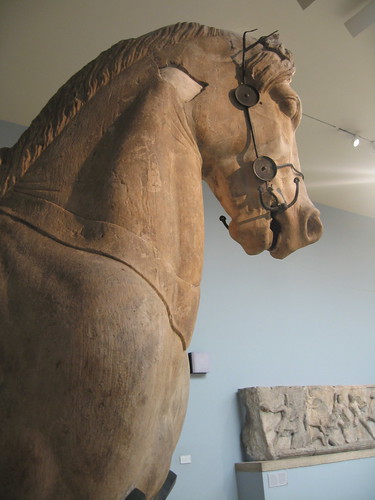
I wanted to touch it so badly. The feeling was almost irresistible. I think it must have been a combination of the heat, my isolation (I hadn't talked to anyone in a week, at least), and the enormity of the museum. I could almost see the statue breathe, and I started to cry.
My first response to the question was to explain what I find ideologically problematic about the discursive structure of the museum. I rambled my way around some issues, in particular, that I have with the representation of African "art objects" during modernity, namely that their presentation of cultural and ritualistic artifacts would seem to suggest that African modernity did not occur. I meandered around the idea that display and possession are linked, and that it can be difficult for people to be aware of how the desire that engenders shapes their responses to what they see.
This was a thoroughly incorrect answer to the question, but I didn't figure that out until the next morning.
Books create in me a feeling of comfort and support that it is difficult to imagine going without for very long. I almost always carry a book (sometimes as many as five) around with me. And so, when I got back to my house, I curled up on the couch with The Bear and stacked all my museum theory around me. [I realize the defensiveness of a position like this. Living in a city like Hartford, with its fierce and unapologetic anti-intellectualism, has made me not insensitive to the image of the intellectual protected and shrouded, even blinded, by books. What I actually feel is something distinct from this image, though.] And so it was with comfort that I thumbed through books thrice-read, with thrice-scripted marginalia.
I found this:
once removed from the continuity of everyday uses in time and space and made exquisite on display, stabilized and conserved, objects are transformed in the meanings that they may be said to carry: they become moments of ownership, commodities.
-
Spencer R. Crew and James E. SimsIt is reading exactly this kind of thing (combined with an upbringing darned through with Marxism) that makes me a bit indignant and irreverent around museums:

I came up with a formula that I imagined summed up the reasons behind my lachrymosity:
1. See Sims and Crew quote.
2. The observation of resituated and condensed culture.
3. Experiencing some degree of wonder at the incandescent unfamiliarity of the objects.
4. Experiencing horror (or something like it) at the combined semiotic and actual (physical) wounding of the objects.
5. The (again) irreverent and automatic (bratty) perception that the collectors, and the museum itself during certain eras, were pilfering bastards. [I realize this is a harsh judgment, and one that is the result of consuming a fair number of incendiary conversations throughout my life about ideological apparatuses...]
"Good," I thought, "I've neatly wrapped up and contained the precise reasons for crying at the British Museum." I should know by now to be wary of good, to be wary of neat. I spent much of the very early hours of this morning reshaping what I had thought via text message - a rather astounding mode of composition!
I've talked before about the deceptively simple clarity with which ideas come to me in the very first moments of waking. Salman Rushdie mentioned it the other night - that writing happens best in the early moments of consciousness, before the paper, before emails, before any of it. It was in these collected moments of clarity that I realized I hadn't answered his question at all - not even remotely. Here's what I thought it was this morning:
When we enter a place like the British Museum (especially now with its new, kind of postmodern vaulted atrium) I think the smallness of our bodies in the face of this gargantuan repository of culture and history (the high ceilings, the vast and encyclopedic collection) cognitively primes us for tears.
And that was it. And, in another way, that wasn't it at all. As I mulled this over - after coffee, after emails - I noticed a half-knot forming in my throat (a sure sign, if ever there was one, that there is more going on than what I am putting into words). I had been thinking all week of that summer I lived in New Jersey, remembering (I had chosen not really to think about this time critically) all the remarkably foolhardy choices I made that summer, shaking my head, slack-jawed at the shape of those months.
They are aspects of my mother's particular means of problem-solving: isolation and unfamiliarity. She encouraged me to leave Connecticut that summer I chose New Jersey and she encouraged me to go away that summer after I finished my graduate program (a phrase that I use, decidedly, as a euphemism for another period of my life that I ended abruptly at around the same time).
So it was that with these intentions (seeking anonymity, removing myself from places on which I had impressed memories) that I headed for Europe. It was after about three months of isolation, of minimal conversation and interaction, of intensive writing and research, that I returned almost ritualistically to the British Museum. Day after day I would enter through the atrium, and each time the lightheadedness would hit me almost instantly. And, at some point during my meanderings, I would feel the undeniable clutch of throat that precedes tears.
I think part of it was that the world doesn't seem quite so enormous with another person bearing witness to your life. When you have had that and then, for whatever reason, you remove yourself from it, the scale of things seems to explode, so that
even a pill, netted in its systematized place, can seem too grand to comprehend.