I finished my masters degree in the midst of a very deep depression. I was questioning my identity, reevaluating the extent to which I took my identity for granted. I was overextending myself - taking a double course load (four courses to the standard two), working a double assistantship load (teaching a course to freshmen that was part of a human rights pilot program, while also being a research assistant to a scholar and artist I admire more than I can adequately express), directing a poetry and graphic design project on a volunteer basis, studying for my exams, applying to PhD programs, and doing extensive departmental committee work. I realize that this is, in many ways, a typical academic workload, but it was a lot for me to take on in the context of having just ended the most significant relationship of my life (a relationship that, for many, many years I believed would be the one that would carry me to old age).
I left for Europe as soon as I had submitted my grades for that final semester. I left with the intention of giving a conference paper in Galway, spending a two week retreat in Co. Donegal during which I would complete a draft of my manuscript (historically-informed poems on Charcot's hysterics), and from there traveling to England with no fixed plans to return. I wanted, desperately, to find some anonymity, to have the space with myself I saw as necessary to figure out what would come next, to re-situate myself to my own positionality. It was from the Holburn branch of the London Public Library that I wrote to my would-be PhD advisor at UCLA, declining his offer of admission. Writing that letter was difficult. Very difficult. It meant, at least temporarily, surrendering an idea and a hope and a plan I had had for myself since I was a very little girl.
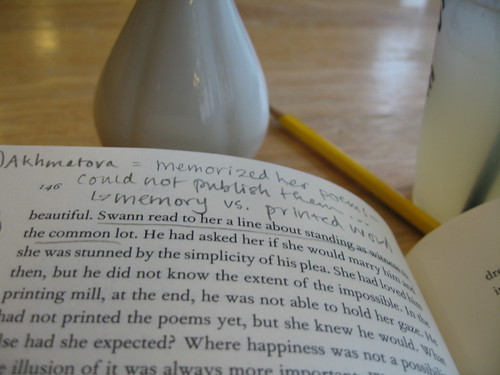
Today - sun shining across my floors, cat basking in the window, coffee in hand - I finished reading Colum McCann's Zoli. And, in what seems almost momentous to me, when I sat down to write about it, what followed was the most scholarly thing I've written since May 2006. Admittedly, it is half-raw and only the very beginnings of an idea that would be properly researched in an academic context, but it kind of thrilled me. I miss it so much. I miss it. I miss it at my very finger tips and in my mind's heart.
Meghan,
ReplyDeleteWhen things shift and we move forward its always wonderful.
This is from Stranger than Fiction
Kay Eiffel: I went out... to buy cigarettes and I figured out how to kill Harold Crick.
Penny Escher: Buying cigarettes?
Kay Eiffel: As I was... when I came out of the store I... it came to me.
Penny Escher: How?
Kay Eiffel: Well, Penny, like anything worth writing, it came inexplicably and without method.
Sarah,
ReplyDeleteI love this.
It reminds me a bit, but in reverse (?), of something Aaron used to say to me. It was from Beloved - "Anything coming back to life hurts." I think there's something to naming the pain of change in order to be able to see it with wonder.
And that's wonder for you - inexplicable and without method!