From the Farm Security Administration - Office of War Information Photograph Collection (Library of Congress)
For just a moment, just a hint of a moment, really, I forgot my grandfather had died. I know it makes no sense. He died seven years ago, but, as I was reading in Atonement of a tank attack in France, I had the sudden, very strong urge to talk to my grandfather about World War II.
Today, I sat on my couch, legs curled under me, blinds and windows down in an effort to block the 93-degree outside, the regular crank (at around 120 bpm) of the ceiling fan the only soundtrack, and I read it over and over, aloud:
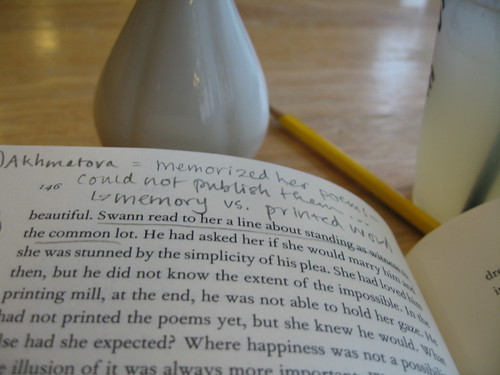
Nevertheless the winter wears on and death follows death. I've tried it, and know how the narrowing-down feeling conflicts with the feeling of life's coming to a point, not a climax but a point. At that point one must, yes, be selective in one's choice if you see what I mean. Not choose this or that because it pleases, merely to assume the idea of choosing, so that some things can be left behind. It doesn't matter which ones. I could tell you about some of the things I've discarded but that wouldn't help you because you must choose your own, or rather not choose them but let them be inflicted on and off you. This is the point of the narrowing-down process. And gradually, as the air gets thinner as you climb a mountain, these things will stand forth in a relief all their own—the look of belonging. It is a marvelous job to do, and it is enough just to approximate it. Things will do the rest. Only then will the point of not having everything become apparent, and it will flash on you with such dexterity and such terribleness that you will wonder how you lived before—as though a valley hundreds of miles in length and full of orchards and all sorts of benevolent irregularities of landscape were suddenly to open at your feet, just as you told yourself you could not climb a step higher.
And I keep coming back to it, butting my head against it like some obstinate 3-year-old: I am terrified of the narrowing-down process. I want to remember the things - more than that! - I want to catalogue, make a record of the things that to me are somehow or other divine.
I find, as my panoply of experiences grows, that most often the concepts I thumb my nose at are the very ones that I come around to accepting sooner or later. I push hard against things. I interrogate them for as long as my endurance possibly allows and then they either break or I believe them. It's a sinister metaphor - but I am generally not very sinister at all, so I will allow myself this image. And I will push, today, against the idea that we must accept the choice to "leave some things behind."
So:
Things that happened yesterday:
Connecticut sped by me (or I sped by it, really) in its high green glory. It is the green of these trees that I miss whenever I am away during summer. I missed it on trips to Kansas or Colorado. I missed this green in that greenest of places (or, at least, it's recognized for its greens): Ireland. The last significant trip I made on a bus was from Galway to Dublin in 2006. I rode that bus across the sparsely treed island immediately after an unhinged man spit in my face. He spit right in my face and it smelled like dip and whiskey-pickled rot. There was a teenager and her mother waiting for the bus, too. Later, they apologized for not trying to help me.
We arrived at dia:beacon and it seemed as though it was going to be rude to eschew the guided tour. So I went. I went with Barbara and our guests and I let Kirsten lead me.
It happened first when I stepped into the On Karawa room. I knew his work already; I had studied it - I had even handled it during my internship at the Wadsworth. It had never particularly effected me before. Maybe it had to do with the space they dedicated to the work at dia; he had an entire room (probably 600 square feet) with about 30 canvases. Maybe it was seeing that many of them together. Something clicked; my throat cinched; and I got it. Staring down mortality - a nice fit with Ashbery (whom I had started reading that morning).
We volunteered to read them out loud. As our mouths pressed out the Sol Lewitt instructions, our voices would sometimes overlap and sometimes synchronize. The instructions were absurd, specific, and ridiculous. And there was I, barely able to hold in my laughter at times. Our inflections lined up occasionally; other times we just missed each other. There was a general tone of sarcastic school marm (how I imagine I sound when I read the instructions for the evaluation forms my students end up having to proctor). [Oh, Sol, we miss you!] The thing of it is, the fact of the fun of it never stops being surprising.
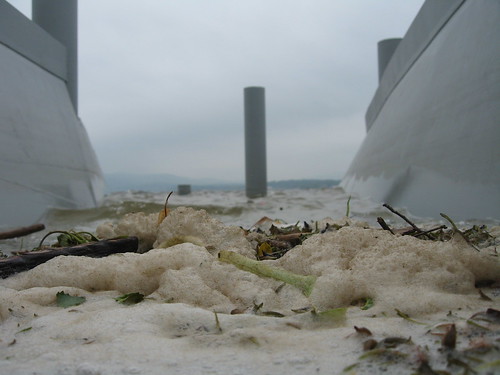
I climbed over and through and around George Trakas's Beacon Point. I stomped on it and splashed in it and abraded my knuckles against its sundry surfaces. I photographed it the way you might macro the skin of a new love, as if by desperate and magnified documentation you will not lose this feeling, this utter and speechless thrill of discovering new crannies and convexes. I didn't want to leave it, ever. I could have slept, curled against one of its posts, fingertips dangling into the grey-dove Hudson.
But it was hot and humid and there were other people (and my job) to consider. And so, I elected not, after all, to sleep with the pier, but to return to the museum. I thought I knew that the only way I really wanted to experience the Richard Serras was to be alone in silence, folded like some embryo against them.
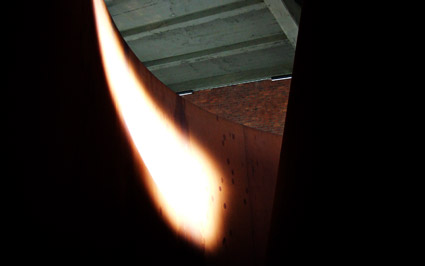
Alone was not an option. I could hear other people and their sounds. I took to it anyway. I stretched my arms as close as I could to the steel. I stomped and tip-toed and listened to my own breath reverberating in the space. And when I got to the center, I laid down on the cold, cold concrete in savasana, the warmth and humidity of my flesh slipped away, absorbed into the floor. I sang - I really sang - for the first time in years. I let unfurl in pianissimo Se Tu M'Ami and it soared and swelled into the high ceilings of what was the loading dock of a Nabisco box factory.
Then it shifted. I finished the aria and just breathed. At the other end of the gallery someone started cooing a Mourning Dove's call. He did it thrice before I reciprocated, the inverted call. We repeated our respective positions, as much claiming territory as making overtures to each other. And before I realized I had decided to be complicit to improvisation, there we were, writing each other. Leaving only very temporary indexes of an intimacy anonymous and irreproducible.
I want it to be clear that by this point I had wept four times. If you have not read Pictures and Tears by Jim Elkins, you must.
As we drove east into Connecticut's center, I saw so many hawks. They soared and soared and played and wobbled. And I could not tear my eyes away. I'm certain that the woman sitting behind me must have thought I had completely lost the plot. She did not stay for the group photograph we all posed for outside the bus. She smelled like Goldschlager - in a good way.
There's more:
I met Salman Rushdie - I will write more about this on The Absurde Round Table (I think it's a more appropriate forum for such musings), but for the moment I will describe the point at which I wept during his talk. He had just finished identifying himself as "crow number one." He was using it to suggest that the political situation that followed the release of The Satanic Verses was more signifier than significance. In a manner not dissimilar from most artists I've encountered, he redirected the topic from biographical occurrences to the research he conducted for his newest book, The Enchantress of Florence. Much to my delight, he took his time describing his research and the way that sometimes the uncanniness of the real trumps anything we might invent. He cited an event of which he read when the lions (who were meant to be released in the square where they would cause an entertaining spectacle of gore) were too bored to maul anyone. And the people were upset. Not only were the people upset, but the historians were, as well, enough so that they recorded this upheaval in mass recreation into the bank boxes of posterity, just waiting for us.
And then, there was one last push to the day. I went for postcolonial literary giantess to retro badass babes. Real Art Ways was hosting the Connecticut roller girls and screening the documentary Hell on Wheels. I squirmed during the film. I took about a hundred pictures after. And then, I had that instant flash of heat and sweat and the next thing I knew I was gripping the green room toilet.
I'll admit it. There is a part of me that hopes my sudden illness was a kind of Stendhal Syndrome (something I promise to adequately describe in a future post - there's a surprising paucity of material on the web about it...). I think you should probably judge me for this and I think I should have been much more hesitant to so readily admit it.
I went home and swaddled myself in the familiarity of handed down silk pajamas and the Gwyneth Paltrow Emma. What comfort was mine!
It's raining again this morning and I stayed in bed far too long, luxuriating in the sound of it and then luxuriating in some poetry. [Times like these I wish for everyone that they have some time in a quiet bed on a June morning to read poems.]
I had picked up John Ashbery's Three Poems for no particular reason but that it was by my bed. It occurs to me that the technique of leaving out - actually composing and then removing text, negative space left behind in the poem - is one that would be particularly well-suited to the personal history and poetic prosthesis series.
I'm off now, to dia:beacon to fight valiantly the urge to wrap my body around and into some Richard Serras.
Later, I'll meet Salman Rushdie. [Right now, you can imagine me swooning all over my office...]
Still later, I'll surround myself with roller derby girls. [Still more swooning...]
There's a part of me that longs for some modern form of Stendhal Syndrome.
It's a rainy June morning. I kept the windows open last night, so there's a cool, wet breeze coming through to my living room along with all the sundry sounds of rain. It feels like England.
My neighborhood, Greencroft Gardens, right off Finchley Road, NW6
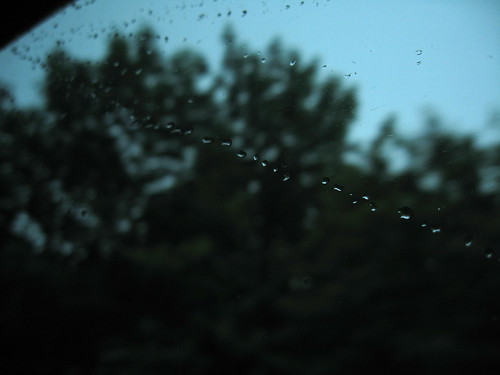
The house in which I lived in South Hampstead was on a quiet block near the Freud Museum. Women pushed prams most mornings, regardless of the weather. The clear plastic awnings that covered the children were speckled with a hundred rain drops, miniscule demi-worlds to capture a million-some details of the neighborhood's skyline. I always wanted to take a photograph from within there. The slate walks turned the deepest grey-brown in the rain and the modest trees smelled more like trees.
But, now, I am in my native Connecticut. The leaves on its stunning trees are now completely open. The Velvet Underground is on the record player and I am thinking of home. I'm thinking of things that we do over and over and return to with wonder. If wonder is the feeling of astonishment - that's not quite it - the feeling of our selves being thrown into a position from where we can no longer depend on our own significance in the face of some object, some occurrence, then how does it relate to something we do ritualistically?
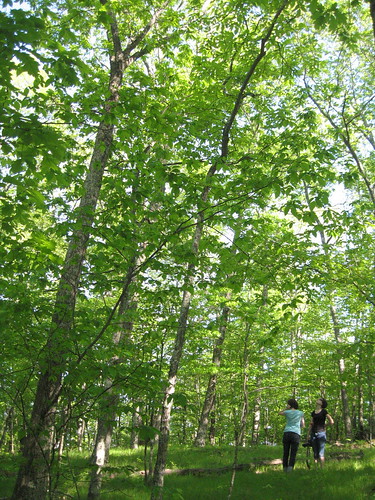
For myself, I'm thinking of the woods, of the course I tend to track through them. Decades before my parents put in the riding ring, before any proper trails were established by Joshua's Trust, I would wander through the woods - so thick that the air looks green - and perch on boulders or test my balance on the edge of a cliff. I repeat these tests, these reveries regularly.
I think of the maps my father made me - my father, the map maker; my father, the poet - he would hide something for me in the woods and make a map, filled with fanciful names and "100-year Sugar Maples"s. He would stain the paper in tea to "age" it and he would burn the edges. He would make, in short, a world of measurement and wonder.
I have a bit of a fraught relationship with academe. I question my motives in toeing its edges; from the time I was quite young (even, perhaps, as young as six) I understood - not in these terms, but I understood nonetheless - that being a member of academe, being part of an intellectual elite, can in effect make ones class status secondary to the work one produces. The idea was intoxicating to me.
I finished my masters degree in the midst of a very deep depression. I was questioning my identity, reevaluating the extent to which I took my identity for granted. I was overextending myself - taking a double course load (four courses to the standard two), working a double assistantship load (teaching a course to freshmen that was part of a human rights pilot program, while also being a research assistant to a scholar and artist I admire more than I can adequately express), directing a poetry and graphic design project on a volunteer basis, studying for my exams, applying to PhD programs, and doing extensive departmental committee work. I realize that this is, in many ways, a typical academic workload, but it was a lot for me to take on in the context of having just ended the most significant relationship of my life (a relationship that, for many, many years I believed would be the one that would carry me to old age).
I left for Europe as soon as I had submitted my grades for that final semester. I left with the intention of giving a conference paper in Galway, spending a two week retreat in Co. Donegal during which I would complete a draft of my manuscript (historically-informed poems on Charcot's hysterics), and from there traveling to England with no fixed plans to return. I wanted, desperately, to find some anonymity, to have the space with myself I saw as necessary to figure out what would come next, to re-situate myself to my own positionality. It was from the Holburn branch of the London Public Library that I wrote to my would-be PhD advisor at UCLA, declining his offer of admission. Writing that letter was difficult. Very difficult. It meant, at least temporarily, surrendering an idea and a hope and a plan I had had for myself since I was a very little girl.
Today - sun shining across my floors, cat basking in the window, coffee in hand - I finished reading Colum McCann's Zoli. And, in what seems almost momentous to me, when I sat down to write about it, what followed was the most scholarly thing I've written since May 2006. Admittedly, it is half-raw and only the very beginnings of an idea that would be properly researched in an academic context, but it kind of thrilled me. I miss it so much. I miss it. I miss it at my very finger tips and in my mind's heart.
Natasha, about whom I only feel very slightly guilty for calling the best dog ever, loved moving rocks.
Natasha, swamp monster
Within the first year we had Natasha we began to become concerned that hunters might mistake her for a deer - the way she moved through the woods, bounding and leaping over fallen trees, stone walls; the color of her coat, that kind of tawny caramel - and so we tied surveyors tape to her collar.
The dogs who come to live with my parents have quite the life - there's a large property with hills, streams, swamps, and obstacles of all sorts around which for them to roam. There's a menagerie of other animals with which they can play (sometimes this playing is more savage than others. To wit, in their first year with us the puppies killed Nora's bunny Jack. At some point the dogs killed a cat they found in the swamp - although, our parents only admitted this to us about a decade after the fact. And then there was the Great Bullfrog (Jerky) Massacre of 1997-2003. The dogs particularly enjoyed catching the big bullfrogs that lived in the swamp the beavers left behind. They would kill them, bring them up to the yard, let them dry for a few days, and then nomnomnom on them.)
One of Natasha's favorite, and most peculiar, pastimes was to run up the hill in the woods and hunt rocks. Big rocks. Rocks that were underground. In another life, she might have been an expert truffle hunter, but as it was she lived with us and found us rocks. She would sniff them out, dig them up, and push them down the hill with her snout so that the yard was often littered with rocks bigger than her head.
She's covered with rocks now. I know it serves a practical purpose - we wouldn't want anyone digging her up - but I like the literal inversion of the tables, her beneath and them above. Weight pressing down and up. I visit here at the end of my runs and walks and hikes, some awkward demi-Heathcliff. (Don't worry - I don't actually exhume her.)
I know that there are many practical reasons my parents had for wanting a tractor - leveling and repositioning land for the riding ring, driveway maintenance, others that don't come to mind - but I like to think that they were inspired by Natasha's tireless rearranging of large rocks to do the same.
My parents went "tractor shopping" on every weekend for at least a year. It was part of what they do together as a couple. They have a whole routine of morning errands that usually incorporate feeding the bunnies at my mom's daycare center, picking up the paper from the general store, buying food for all the animals, and (at that point) tractor shopping.
During this tractor shopping year, my parents became increasingly convinced that I should marry the tractor salesman. It always kind of mystified me that they were seeing the same tractor salesman with such regularity that they could decide that he'd make a good son-in-law. But there you have it, they're very particular shoppers, my parents. They also have a penchant for selecting spouses for their children - the tractor salesman for me, the horse dentist (or, anyway, it's some man who has an equally esoteric equine-related job) for Nora, some linguist on TV for Patrick. They're regular Mrs. Bennets, my parents.
The urge to wed me off seems to have subsided along with the actual purchase of the tractor. They seem to be delighted by (in possession of minor injuries following) tractoring. To me, it seems as though they just move things around recreationally (although, arguably, my parents have a very labor-centered notion of recreation). (In full disclosure, I should admit to a deep abhorrence for lawn equipment dating back to the time in middle school that Sandy Mann showed me the toe he mowed off his foot. So, it's quite possible, I suppose, that the moving of things my parents do with the tractor is totally necessary, but that I am just too undereducated in the ways of lawn equipment to understand what's going on.)
At any rate, I prefer to think of the tractor as a kind of homage to Natasha.
In addition to being one of my favorite things to watch, this video shows rocks, do-it-yourself construction projects, and Natasha with surveyors tape.
My friends alternate between calling me quirky and eccentric. That, I think, is as good a measure as anything.
Also: I have developed an unconventional relationship to popcorn since working at Real Art Ways.
Also, also: I like to oil my desk.
In the winter, I like to watch clemintine peels combust in the woodstove.